Why Do AI Agents Forget? The Statelessness Problem
AI agents forget everything between sessions because LLMs are stateless: here's why, and what actually has to change to fix it.
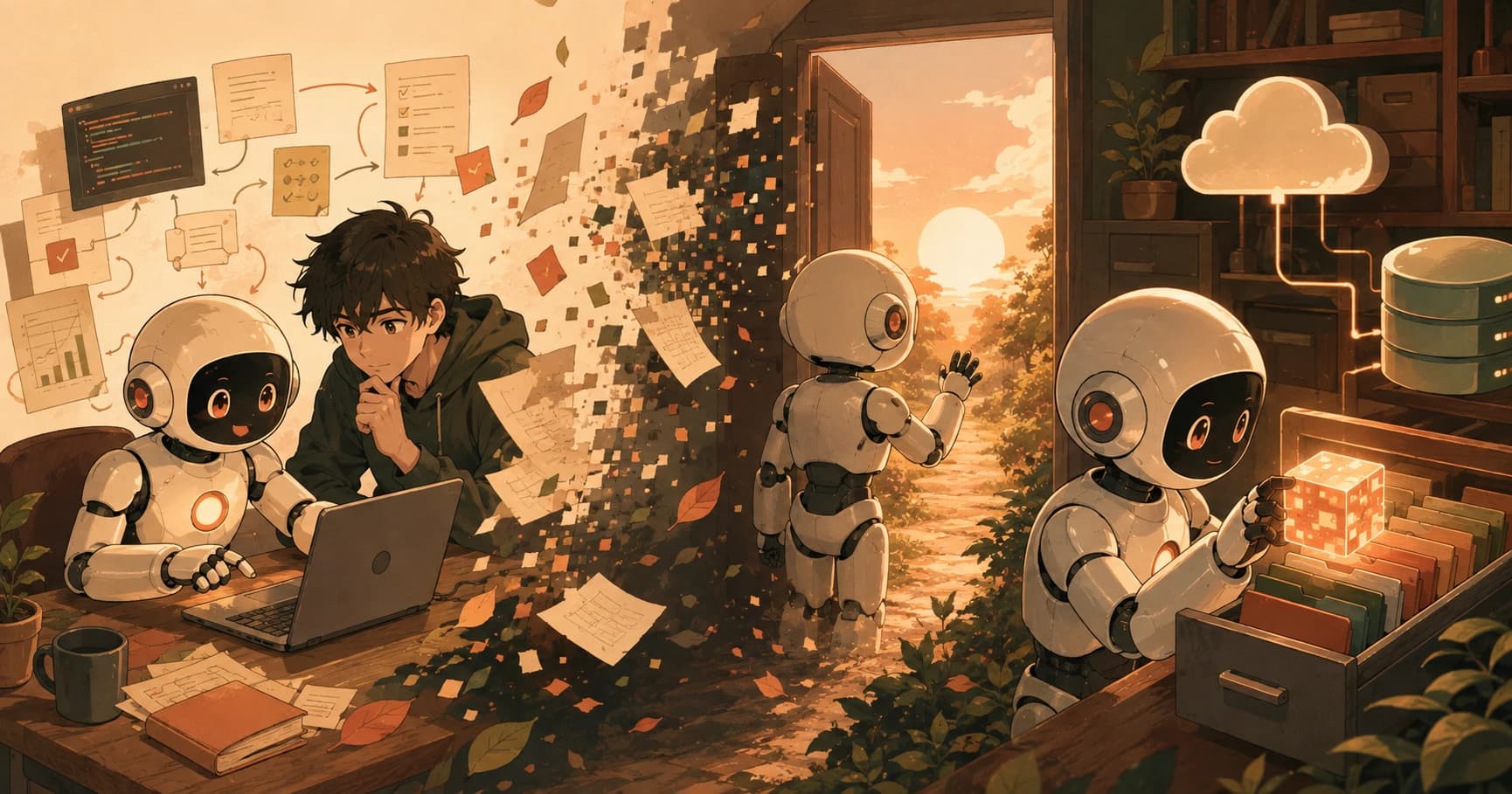
You spend forty minutes with Claude Code chasing a bug, and around minute thirty it finally clicks: the failing test wasn't a logic error at all, it was a stale cache key. You fix it together, agent and all, and it feels like a real breakthrough. You close the terminal. Tomorrow, you open a fresh session and ask a follow-up question about the same bug. The agent has no idea what you're talking about.
AI agents forget between sessions because the underlying model is stateless: every request it processes is handled independently, with nothing carried over from the last one. The context window you're typing into isn't a memory, it's temporary working space for the current conversation only, and when that conversation ends, everything in it disappears unless something outside the model explicitly saved it first.
Key Takeaways
- Large language models are stateless by design: each call in, response out, then the model discards everything it just computed.
- The context window is working memory for one session, not storage; nothing you type is retained once the session closes.
- "Just paste more context back in" is a real workaround, but it costs tokens every time, doesn't scale indefinitely, and (as the next lesson shows) can quietly make answers worse, not better.
- Giving an agent real memory means building a system next to the model, not asking the model to somehow remember on its own.
- This isn't a bug to be annoyed by. It's an engineering trade-off, and understanding it is the foundation for the rest of this module.
Why Do AI Agents Forget Between Sessions?
AI agents forget between sessions because the model answering you has no persistent internal state: it doesn't hold onto anything from one API call to the next unless that information is explicitly resent as part of the input. Every time you send a message, the model receives a full package of text, the current context window, and generates a reply based only on what's inside that package.
Once the reply is sent, the model has moved on. There's no background process quietly keeping a running memory of your project, your preferences, or yesterday's fix.
This is easy to misread as the model "getting distracted" or "losing focus" the way a person might. It's a more literal kind of gone: the text isn't fading from attention, it simply isn't part of the input anymore. If a fact was in message twelve and your conversation is now on message sixty, and message twelve scrolled out of the model's window, that fact isn't being ignored. It doesn't exist for the model at all, on this turn.
That distinction matters because it tells you where the fix has to live. You can't coach a stateless system into remembering harder. You have to change what gets sent in, a discipline Anthropic itself describes as treating the context window as a finite, curated resource rather than an ever-growing transcript.
The Context Window Is a Scratchpad, Not Storage
The context window behaves like a scratchpad you fill up and then wipe clean, not like a filing cabinet where things stay put until you go looking for them. Everything the model can "see" on a given turn, your instructions, the conversation so far, any files or tool results you've shared, has to physically be inside that window. When the window fills up or the session ends, none of it is retained anywhere the model can reach later.
It helps to think of it less like a notebook and more like short-term working memory. It's useful and fast, and it's completely gone the moment you stop actively holding it. A notebook persists whether or not you're looking at it. A scratchpad gets erased.
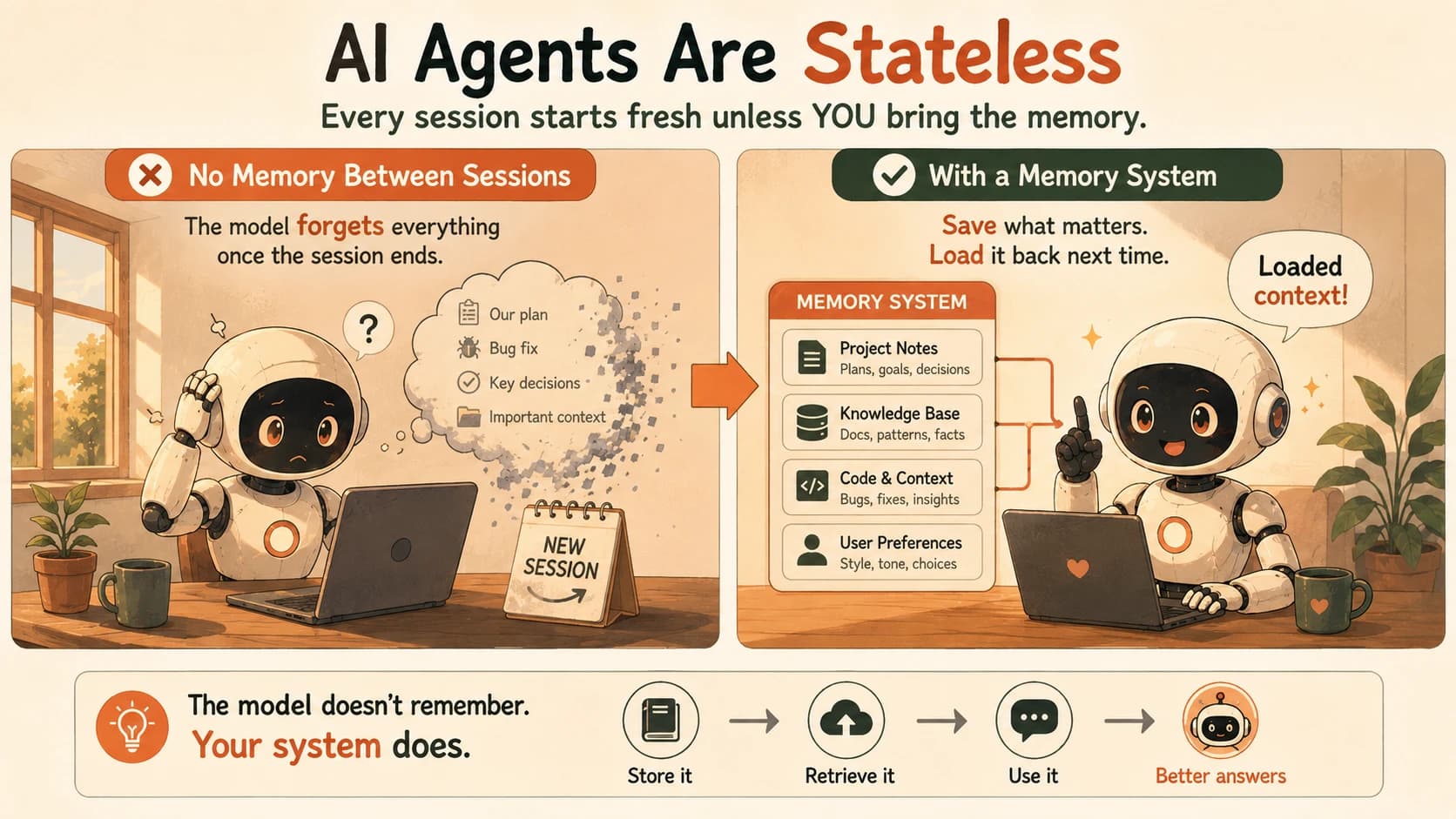
If you want to see this directly, ask Claude Code or Cursor a specific question about a project decision from three sessions ago, in a brand-new session, before giving it any of that context. It won't know, and that's not a glitch, it's the architecture working exactly as designed.
This is also why longer context windows, covered in more depth in Beyond the Prompt's context window lesson, don't solve the memory problem on their own. A bigger scratchpad still gets wiped. It just holds more before that happens.
What Actually Gets Lost When a Session Ends
What gets lost is everything you and the agent worked out together that never made it into a file: the reasoning behind a decision, a convention you settled on, a dead end you already ruled out. None of that is written down anywhere unless someone deliberately puts it there.
I've had Claude Code re-diagnose the exact same off-by-one bug twice in one afternoon, because the second session had no way of knowing the first one had already found it. The fix itself lived in the code, so that part carried over. The reasoning, why we ruled out three other causes first, didn't, and the agent burned real time rediscovering it.
That's the shape of what disappears: not the artifacts (your code is still there, your files are still there), but the decisions, the discarded approaches, and the "we already tried that" knowledge that only ever existed inside the conversation. Later in this path you'll build the habit of writing decisions down as they happen, precisely so this kind of loss stops being automatic.
Why "Just Paste More Context In" Doesn't Work
Pasting your entire history back into every new session doesn't work as a real fix because it gets expensive fast and it doesn't actually persist anything, you're just re-explaining, every single time, rather than storing. Every additional message, transcript, or file you paste back in costs tokens, and tokens cost money and processing time. Do that at the start of every session on a real project and the overhead adds up quickly.
There's a second, sharper problem waiting here. It turns out that dumping a large amount of context back into a model doesn't just cost more, past a certain point it can make the model's answers measurably less accurate, even when every fact it needs is technically present. That phenomenon has a name, and the next lesson in this module reproduces it with a real number.
So re-pasting everything is neither cheap nor safe at scale. It's a stopgap, not a fix, which is exactly why this problem needs an actual engineering answer instead of a bigger prompt.
Memory Is an Engineering Trade-off, Not a Toggle
Giving an agent real memory means deliberately choosing what to persist, where to store it, and when to load it back in, not flipping a "remember things" switch that doesn't exist. Every option carries a cost. A plain text file is cheap and simple but only scales so far. A database can hold much more but adds infrastructure you have to run and maintain. A vector store enables searching by meaning rather than exact wording, at the price of more moving parts and more places things can go wrong, the trade-offs covered in database and vector-store memory.
None of that is a downside of AI agents specifically. It's the same trade-off every stateless system has always faced: speed and simplicity now, or durability and cost later. Once you understand why AI agents forget in the first place, the rest of this module walks through the real tools for making that trade-off deliberately, files, structured notes, databases, vector memory, instead of by accident.
Your Lab
Do real work in a first Claude Code session
Open Claude Code in any repo (a scratch project is fine) and give it a genuine multi-step task: for example, "add a small function, write one test for it, and explain why you structured the test the way you did." Let it reach a real decision point, not just a one-line answer, and make sure at least one non-obvious choice gets made along the way.
Close the session completely
End that session fully, don't just start a new chat inside the same window. You want a genuinely fresh session with no shared history, the same way tomorrow's session would have none.
Start a brand-new session and probe what's gone
In the new session, without pasting anything back in, ask a specific follow-up: "Why did you structure the test that way?" or "What was the reasoning behind [the decision from step 1]?" Watch exactly where the answer breaks down.
Log the exact loss in learning-log.md
In a learning-log.md file in your repo, write down precisely what the second session knew and didn't know: what it could still see (the code itself, if you kept it), and what it had no access to (the reasoning, the ruled-out alternatives, the decision itself). Be specific, not "it forgot everything."
Done? You've completed Lesson 19.01.
FAQ