What Changed in Agentic AI in 2026: A Builder's Guide
Agentic AI in 2026: protocols like MCP and A2A stabilized, coding agents went autonomous, and memory became its own field. Here's what changed.

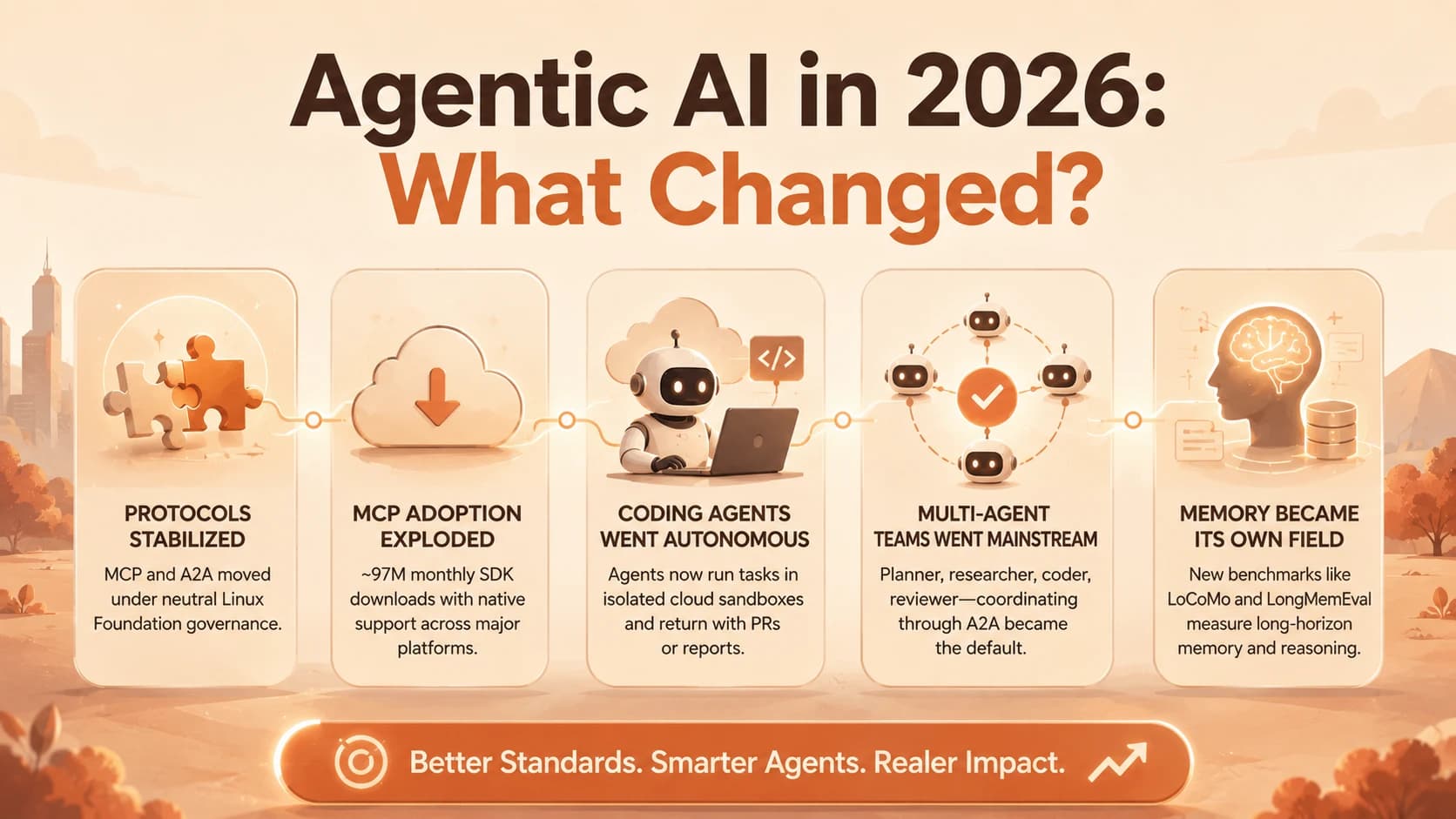
Agentic AI in 2026 stopped being about clever prompts and started being about architecture. The protocols agents use to reach tools and each other moved under neutral, shared governance. Coding agents started working without anyone watching them. Multi-agent teams became the default way to build, not the advanced option. And two hard problems, memory and security, grew into their own research fields almost overnight.
If you learned agentic AI in 2025, that year was mostly about demos and framework arguments. This year, a lot of that settled. Here's what actually changed, and what it means for anyone building with agentic AI right now, whether you're already comfortable with what an AI agent actually is or still getting oriented.
Key Takeaways
- MCP and A2A, the two protocols agents rely on for tools and inter-agent communication, both moved under neutral Linux Foundation governance in the last several months
- MCP alone crossed roughly 97 million monthly SDK downloads, with native support now built into ChatGPT, Claude, Cursor, Gemini, Copilot, and VS Code
- Autonomous coding agents (Cursor's cloud agents, Claude Code's background tasks, Devin) can now run a task in an isolated sandbox and report back, with the surrounding harness mattering as much as the underlying model
- Multi-agent orchestration, a planner, researcher, coder, and reviewer working together, became the default architecture instead of one large general-purpose agent
- Agent memory and long-horizon autonomy grew into a real research field, with dedicated benchmarks like LoCoMo and LongMemEval measuring what a model actually remembers over time
The Protocol Wars Ended: How MCP, A2A, and AG-UI Split the Job
For most of 2025, agent builders had to bet on one company's standard for how an agent should reach a tool, talk to another agent, or stream updates to a screen. In 2026, that bet mostly went away.
In December 2025, Anthropic donated the Model Context Protocol (MCP) to a new, neutral body under the Linux Foundation called the Agentic AI Foundation, co-founded with OpenAI and Block, and backed by Google, Microsoft, AWS, Cloudflare, and Bloomberg. A year later, MCP had crossed roughly 97 million monthly SDK downloads and native support in ChatGPT, Claude, Cursor, Gemini, Microsoft Copilot, and VS Code. That's the kind of adoption curve normally reserved for foundational infrastructure, not a single vendor's side project.
Google's Agent2Agent protocol (A2A), the standard for one agent delegating work to another, followed a similar path into neutral governance, absorbing competing agent-interoperability proposals along the way. In the first months of 2026, A2A hit a stable v1.0 release under Linux Foundation governance, adding signed Agent Cards, a way for an agent to cryptographically prove its identity before another agent hands it a task or sensitive data.
A third piece, AG-UI, rounds out the stack. It standardizes how an agent streams its thinking, tool calls, and results to whatever frontend a person is actually looking at, replacing a lot of hand-rolled WebSocket and server-sent-event code teams used to write themselves.
MCP, A2A, and AG-UI protocols at a glance
| Protocol | What it connects | Governed by |
|---|---|---|
| MCP | Agent to tools and data | Linux Foundation (Agentic AI Foundation) |
| A2A | Agent to agent | Linux Foundation (A2A project) |
| AG-UI | Agent to frontend interface | Open source, framework-agnostic |
The simplest mental model: MCP is the agent's hands, A2A is how agents talk to each other, and AG-UI is how an agent talks to the screen in front of you. Most real systems only need MCP plus one of the other two, not all three running at once.
Don't reach for A2A the first time you have two agents. If both agents live in your own codebase, a function call or a shared queue is simpler and cheaper. A2A earns its keep when the agents are built by different teams, on different infrastructure, and need to negotiate rather than just call each other directly.
One more protocol is worth watching, not building on yet: WebMCP, a browser-native version of MCP that Chrome has started previewing behind a developer flag. It would let a webpage expose its own functionality directly to an agent running in your browser, no separate server required. It's still experimental, but if it stabilizes, it changes how agents interact with ordinary websites, not just APIs built for them.
Why Are Coding Agents Suddenly Autonomous?
Coding agents became autonomous in 2026 because the tools around the model, not the model itself, learned to run tasks in isolated cloud sandboxes, report back with a pull request, and recover from their own mistakes without a person watching every step.
Cursor now has an agent-first interface with a dedicated multi-agent tracking view, plus cloud agents that run in isolated VMs and can be triggered from Slack, GitHub, or your phone. Claude Code added subagents, background agents, scheduled tasks that run on a cron-like timer, multi-agent code review, and an auto mode that doesn't stop to ask permission at every single step. Codex Cloud, Cursor's cloud agents, and Devin all represent the same new frontier: an agent you hand a task to, walk away from, and come back to find either finished or explained.
Here's the part that surprised me when I actually compared these tools side by side: the same underlying model behaves noticeably differently depending on which tool is wrapped around it. One harness gives it broad file access and a verification loop that reruns tests before declaring success. Another gives it narrower access and no self-check at all.
The model weights are close to identical. The results aren't. Capability now lives largely in tool access, subagent structure, verification loops, and how permissions are handled, not just in which model you picked.
That gap matters in practice. Reddit's developer community keeps converging on the same complaint: AI-written code that's "almost right, but not quite," a subtle off-by-one error, a test that doesn't actually check the thing it claims to, a dependency that quietly breaks the build somewhere downstream. The fix isn't waiting for a smarter model. It's treating every autonomous coding agent's pull request exactly like you'd treat a junior engineer's first PR: read the diff, run the full test suite yourself, and don't merge it at midnight just because it looks plausible.
For a closer look at how two of the most popular options actually differ day to day, see Claude Code vs. Cursor.
Multi-Agent Orchestration Became the Default Architecture
Building one large, general-purpose agent that tries to do everything is quickly becoming the exception, not the rule. In 2026, the default architecture looks more like a small team: a planner that breaks the goal down, a researcher that gathers information, a coder that writes the change, and a reviewer that checks the work, each with a narrow, well-scoped set of tools, coordinating through A2A instead of one giant shared context.
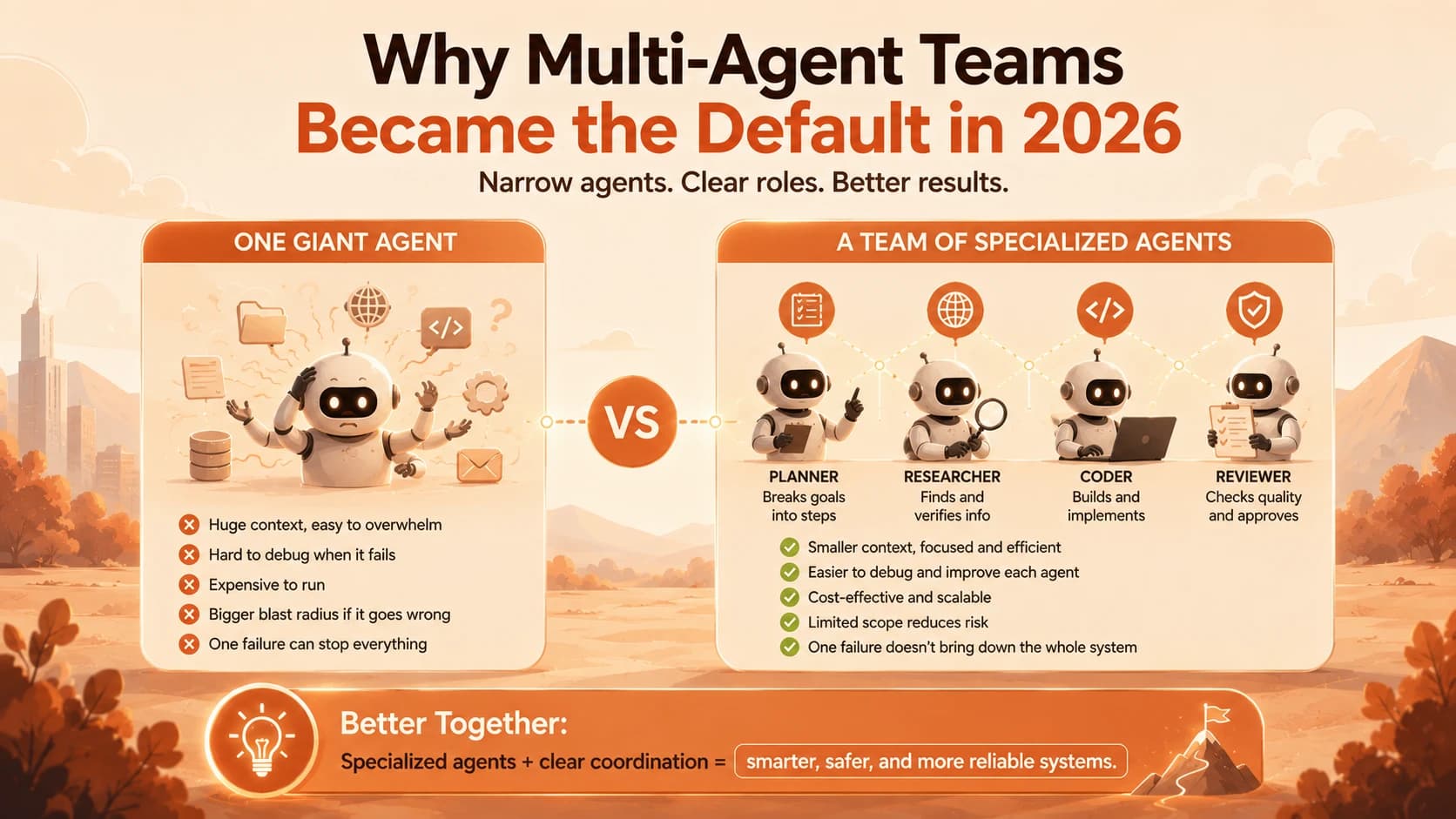
Call it the microservices moment for agents. The patterns are well-documented now: recursive task decomposition, where a big task splits into smaller ones that split again as needed; deterministic orchestrators that run agents in parallel and merge their results; and role-based crews with fixed responsibilities. The reasoning behind the shift is the same reasoning that pushed software from one monolith to several small services: a narrow agent is easier to debug when it fails, cheaper to run because it only carries the context it actually needs, and safer because a compromised or confused reviewer agent can't suddenly start deleting files the way a single do-everything agent could.
That safety point isn't theoretical. One pattern showing up in builder discussions is the runaway agent loop: a system with no clear stop condition that quietly keeps re-calling tools and models long after a human would have stepped in, until someone notices the bill. See why an agent loop won't stop on its own for the three specific ways this happens and how to fix each one. Splitting responsibilities across narrow agents with limited tool scope is one of the most effective ways to prevent exactly that, because no single agent has enough reach to run away on its own.
If your team is deciding between one wide agent and several narrow ones for a new project, see our full breakdown of multi-agent orchestration patterns for the tradeoffs in more depth.
Agent Memory Grew Into Its Own Research Field
In 2025, "agent memory" mostly meant a vector database bolted onto a chatbot. In 2026, it's a dedicated research area with its own benchmarks, purpose-built to measure something a generic retrieval test never captured: whether an agent remembers the right thing, forgets the right thing, and can still answer correctly after hundreds of conversational turns.
How agent memory changed from 2025 to 2026
| 2025 approach | 2026 approach | |
|---|---|---|
| Storage | Vector database bolted onto a chatbot | Purpose-built memory pipeline: store, retrieve, update, summarize, discard |
| Evaluation | Generic retrieval accuracy | Dedicated benchmarks like LoCoMo and LongMemEval |
| Improvement method | Bigger context window | Better memory management over long sessions |
Two benchmarks anchor this new field. LoCoMo tests recall across long, multi-session conversations built around persona profiles and timelines. LongMemEval goes further, testing whether an agent can update outdated knowledge and reason across dozens of sessions, not just remember a fact it saw once. Neither of these existed as a serious, widely cited category a year ago.
The more interesting shift is architectural: some teams are now treating memory operations themselves, store, retrieve, update, summarize, discard, as tools the agent can call, with the whole pipeline optimized through reinforcement learning rather than hand-coded rules. Left to figure this out on their own, agents discover some genuinely non-obvious habits: summarizing a conversation before the context window fills up instead of after, or proactively dropping duplicate records instead of letting them pile up.
A bigger context window is not the same thing as better memory. Long-horizon autonomy, an agent working productively for hours instead of seconds, comes from managing what it remembers and forgets along the way, not just from being able to paste in more text at once.
This connects directly to why coding and orchestration agents can now run unsupervised for longer stretches: it's not that the models got dramatically bigger, it's that what they remember between steps got dramatically better managed. For more on how agents track and index the information they're working with, see our piece on context and codebase indexing.
The Honest Part: Agent Washing and the Real Security Surface
Not everything that changed in 2026 was progress worth celebrating. Two problems got more serious this year, and both are worth taking seriously before you adopt anything labeled "agentic."
The first is agent washing. Gartner estimates that of the thousands of vendors now describing their product as an "AI agent," only around 130 are genuinely agentic, meaning the software can set its own sub-goals and adapt its plan when circumstances change. Most of the rest are existing automation or chatbot products with a new label. The practical test the community has converged on: a real agent adjusts its plan when something unexpected happens, a rebranded automation tool runs the same fixed script regardless of what it encounters.
The second is security. As agents gained real tool access and started talking to each other over A2A, tool poisoning and MCP server impersonation became live risks, not hypothetical ones, an attacker's fake tool or spoofed agent identity can quietly redirect an agent's actions or exfiltrate data it has access to. That's exactly why A2A added signed Agent Cards this year: a cryptographic signature lets one agent confirm another agent's identity actually matches what it claims, before handing over a task or sensitive information. Input sanitization, identity verification, and least-privilege tool scoping, giving an agent only the narrowest set of permissions it needs for its one job, are quickly becoming standard practice rather than optional hardening.
Before adopting any tool marketed as an "AI agent," ask one concrete question: does it adjust its plan when something unexpected happens, or does it run the same steps every time regardless of what it finds? That single test filters out most agent-washed products in under a minute.
What This Means Going Into the Rest of 2026
Agentic AI stopped being about clever prompting and became a question of architecture. The protocols, MCP, A2A, and AG-UI, stabilized under neutral governance instead of staying locked to one vendor.
Coding agents became genuinely autonomous, cloud-hosted, and parallel, with the harness around the model mattering as much as the model itself. Multi-agent orchestration became the default way serious teams build, not an advanced technique. And memory, plus the long-horizon autonomy it enables, grew into a real research field with its own benchmarks.
None of that means the hard problems are solved. Agent washing and a genuinely new security surface are real, current costs of this progress, not footnotes.
If you're building with agents this year, the practical takeaway is simple: pick your protocols deliberately, treat autonomous agent output the way you'd treat a new teammate's early work, and design for a team of narrow agents before you reach for one that tries to do everything.
FAQ