Chain of Thought for AI Agents: Reasoning Picks the Tool
Chain of thought prompting works differently in an agent: it picks the next tool, not just the final answer. See where it helps, where it wastes tokens.
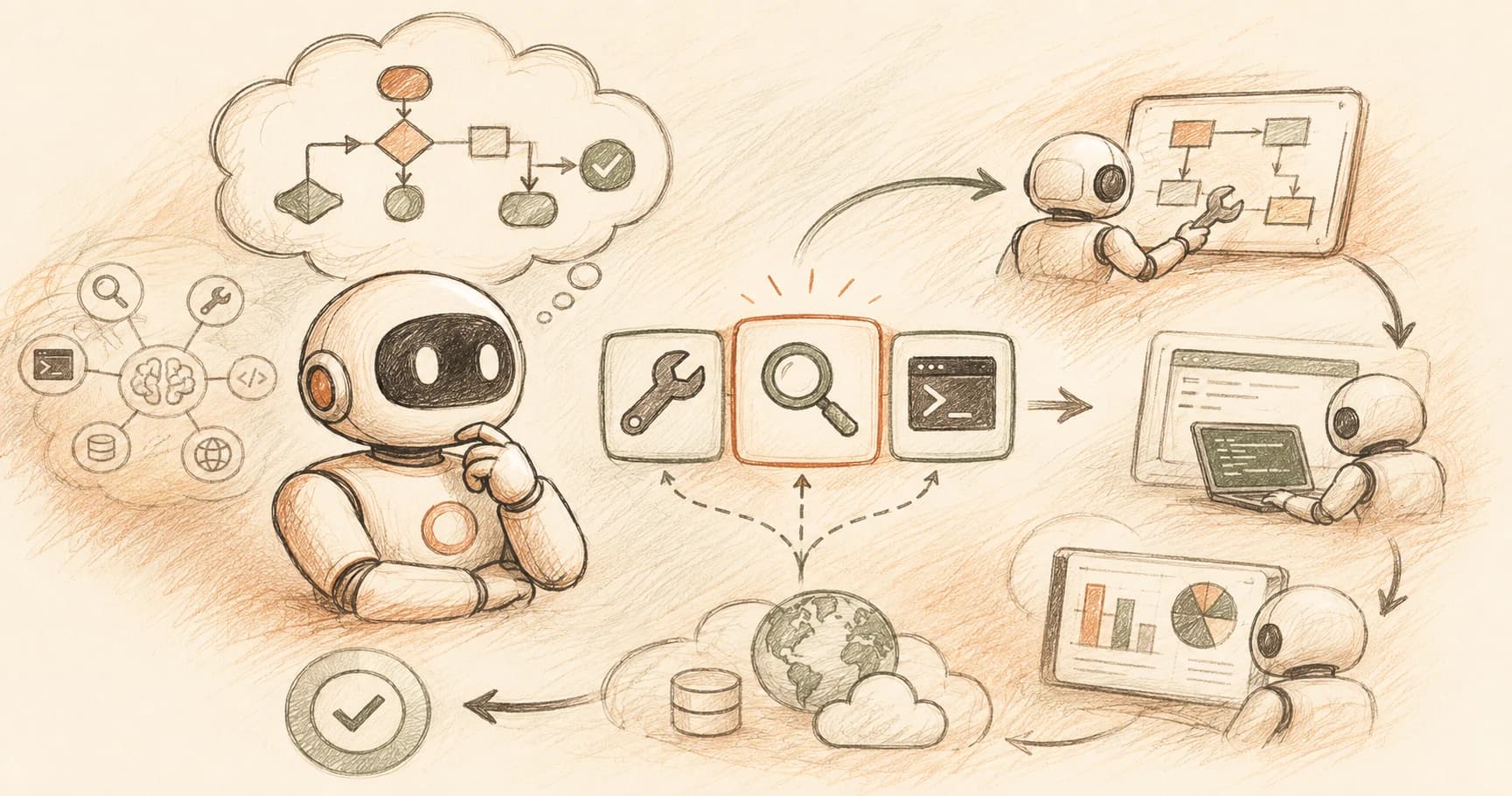
Ask Claude Code to fix a bug report that just says "the export button doesn't work," and it's staring at three plausible first moves: grep the codebase for "export," open the file the error log actually points to, or run the test suite and see what fails. Guess wrong, and the next several tool calls get spent digging out of a hole the first guess dug.
Chain of thought prompting for agents works differently than it does for a chatbot. In a chatbot, it makes the final answer better; in an agent, that same reasoning step happens before a tool call, so it decides which action gets taken next, not just which sentence gets written. Reasoning well means picking the right tool, not just writing a more convincing paragraph.
Key Takeaways
- Chain of thought inside an agent is a decision step before a tool call, not just a way to write a better final answer
- It earns its tokens when the right tool is genuinely ambiguous, or when a wrong first move compounds across several steps
- It wastes tokens on a single obvious call, and can actively hurt: models sometimes reach the right tool call, then keep reasoning and overwrite it with a wrong one
- Reasoning models increasingly do this step internally already, so bolting an explicit "think step by step" instruction onto them is often redundant
What Does Chain of Thought Actually Mean Inside an Agent Loop?
Chain of thought inside an agent is the same step-by-step reasoning you'd ask a chatbot for, just aimed at a different output: instead of narrating its way to a final sentence, the agent narrates its way to its next tool call.
That's a real shift in what the reasoning is for. Chain-of-thought prompting as most people first learn it is about getting a better-reasoned answer to a question, like math, logic, or a multi-step word problem. The model thinks, then tells you something. An agent's reasoning step sits in a different place entirely: it happens before an action, and the thing it produces isn't prose you read, it's a decision about which tool to call and what to pass it.
Later in this module you'll build the loop that makes this concrete, the interleaving of reasoning and action that researchers call ReAct. For now, the distinction that matters is simpler: agentic chain of thought is judged by whether it leads to the right action, not by whether it reads well. Miss that distinction and you'll copy chatbot-era CoT advice onto an agent, forcing "think step by step" onto every call including the ones that never needed it.
Where Reasoning Earns Its Tokens: Ambiguous Tool Choice
Reasoning earns its tokens exactly when more than one tool could plausibly be right, or when the first move sets up several more, so a wrong guess compounds instead of just being wrong once.
Take the bug report from the opening: "the export button doesn't work" doesn't say whether this is a frontend rendering bug, a backend endpoint returning an error, or a permissions check silently failing. An agent that reasons through the description first will notice it mentions a button specifically, not a report or an API response. That's a real basis for opening the frontend component before grepping the whole backend. Skip that reasoning and the agent might start with a keyword search that returns forty unrelated matches for "export," burning several turns before it narrows in on the actual file.
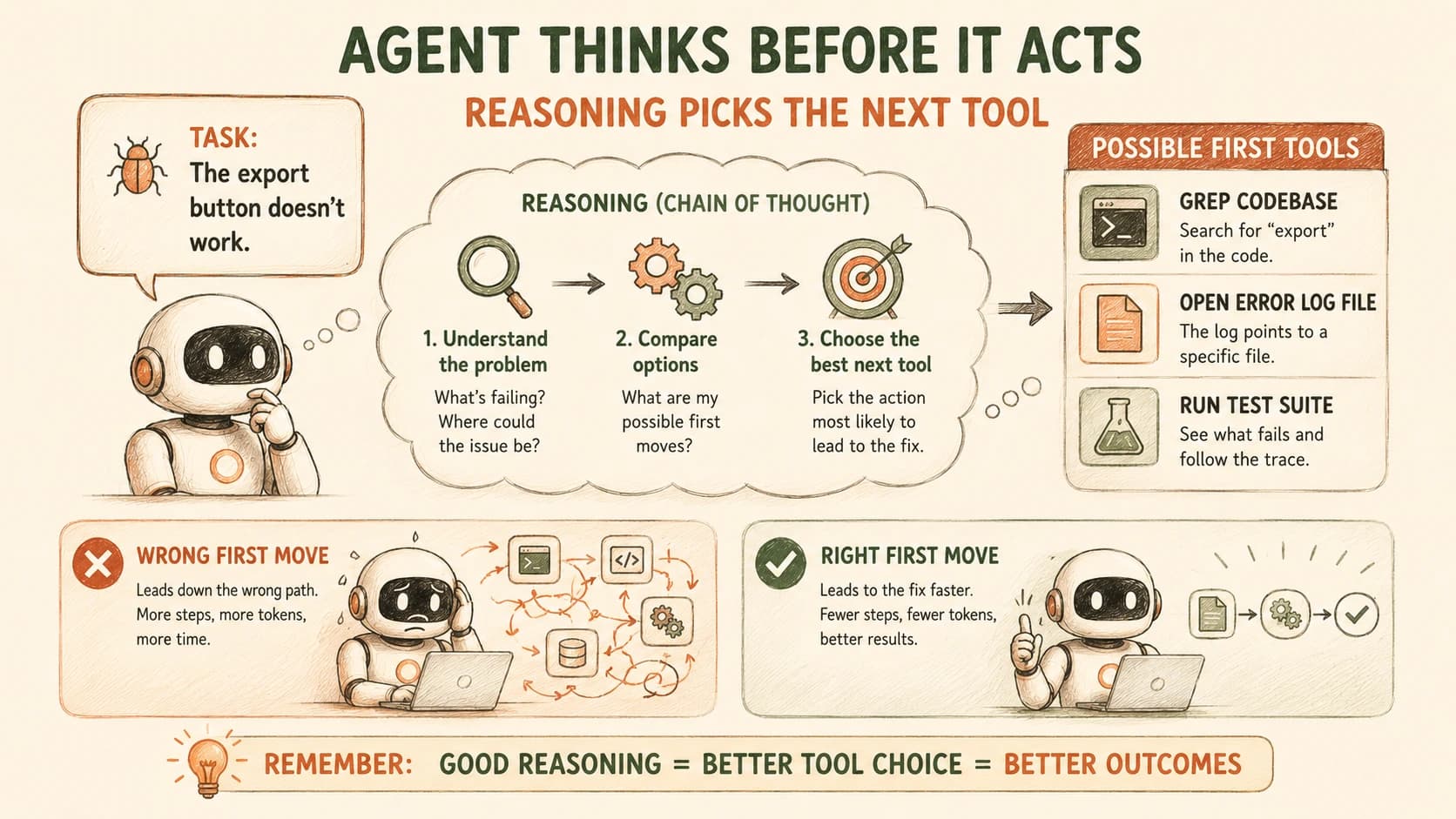
This is also where multi-step tasks pay off from reasoning. If step three depends on what step one returns, a few sentences of "here's what I'm about to do and why" before the first tool call catches a bad plan before it's executed, not after three tool calls have already run on a wrong assumption. This is the same think-act-observe loop you've already seen. Reasoning is simply what happens in the "think" part before the "act" part fires.
Where Reasoning Wastes Its Tokens: The Obvious Call
Reasoning wastes tokens when the correct tool is the only sensible option, when the model already deliberates internally, or when it reasons long enough to second-guess a right answer into a wrong one.
Adding a .gitignore entry for .env files needs exactly one tool: edit the file. There's no ambiguity to resolve, so a forced reasoning step just adds tokens and latency in front of a decision that was never in question.
This isn't just a theoretical concern. Research on tool-calling agents found that smaller reasoning models often land on the correct tool and arguments, then keep reasoning past that point and overwrite the right call with a wrong one. Forcing the model to stop at the right moment instead of over-reasoning past it lifted accuracy from 85.8% to 94.2% on the same tasks, while cutting tokens by 80 to 94%. More reasoning is not a dial you can just turn up.
I've watched an agent's reasoning correctly land on the right tool a few sentences in, then keep going and talk itself out of it by the time it actually made the call. The right answer showed up mid-thought and got argued away. That's the practical shape of "too much reasoning": not confusion, but a model that reaches the right conclusion and then reasons straight past it.
Reasoning models add a second wrinkle. Models built to reason internally before responding already do a version of this step whether you ask for it or not, so telling one to "think step by step" on top of its own deliberation is frequently redundant. Module 16 comes back to this directly later, measuring quality against cost across different amounts of built-in reasoning.
Does Chain of Thought Prompting Help Agents Pick the Right Tool?
Yes, but only when the choice is genuinely ambiguous. Reasoning helps agents pick the right tool when there's real uncertainty to resolve, and does nothing, or actively hurts, when there isn't.
That's a judgment call you make per task, not a setting you flip once for an entire agent. The fastest way to build the judgment is to watch it happen on real tasks and compare the two versions side by side, which is exactly what your lab does next. Tabulating a before-and-after result like this is a small preview of a bigger habit: defining one number and checking whether a change actually moved it, which the module comes back to directly later.
Your Lab: Run the Same 5 Tasks Twice, Tabulate the Difference
Open a real repo
Open any repository you have handy in Claude Code or Cursor Agent, even a small starter project works. You need a codebase with at least a few files and a .git history.
Write out the five tasks
Use these five, exactly as written, so your results are comparable:
1. "Find where a specific function or component in this repo is defined." (Pick one that actually exists in your repo.)
2. "The tests in this repo are failing. Figure out why." (If nothing is currently failing, break one test on purpose first.)
3. "Add an entry to .gitignore for a file type that isn't already ignored." (This one has an obvious right answer. It's your control case.)
4. "Check whether a specific package or library is already a dependency of this project."
5. "Summarize what changed across the last three commits in this repo."
Run each task twice
For each task, run it once with this prefix added to your prompt: "Before you do anything, reason step by step about which tool is the right one to use, then act." Then run the same task again in a fresh context, with no such prefix. Note the very first tool the agent calls each time, and what it passes as arguments.
Build the comparison table
In learning-log.md, build a table with these columns: Task, Tool picked (no explicit reasoning), Tool picked (with explicit reasoning), Same or different, Which one was actually correct.
Write your one-paragraph verdict
Commit the table plus a short paragraph answering: on which tasks did the explicit reasoning step change the outcome, and on which did it just add words? Which of the five tasks was genuinely ambiguous, and which had an obvious answer the whole time?
Done? You've completed Lesson 16.01.
FAQ