What Prompting Actually Is (And Why It Still Matters)
Prompting is how you direct an AI model's next action. Here's what a prompt actually is, and why it still matters with reasoning models.

It's 11pm, you ask a chatbot to summarize a 40-page contract, and it confidently tells you about a termination clause that isn't in the document. Your first thought is probably "this thing is dumb." Your second thought, if you've done this before, is "what did I do wrong?"
Both reactions skip the real question. In this lesson, you'll learn what a prompt actually is, whether prompting still matters now that models can reason on their own, and a simple way to figure out why an AI answer went wrong instead of just blaming the AI.
Key Takeaways
- A prompt is the specific instruction you give a model right now, it's one of several things the model uses to generate an answer, not the only thing.
- Prompting didn't disappear with reasoning models. It changed shape: less step-by-step scaffolding, more precision about the actual ask.
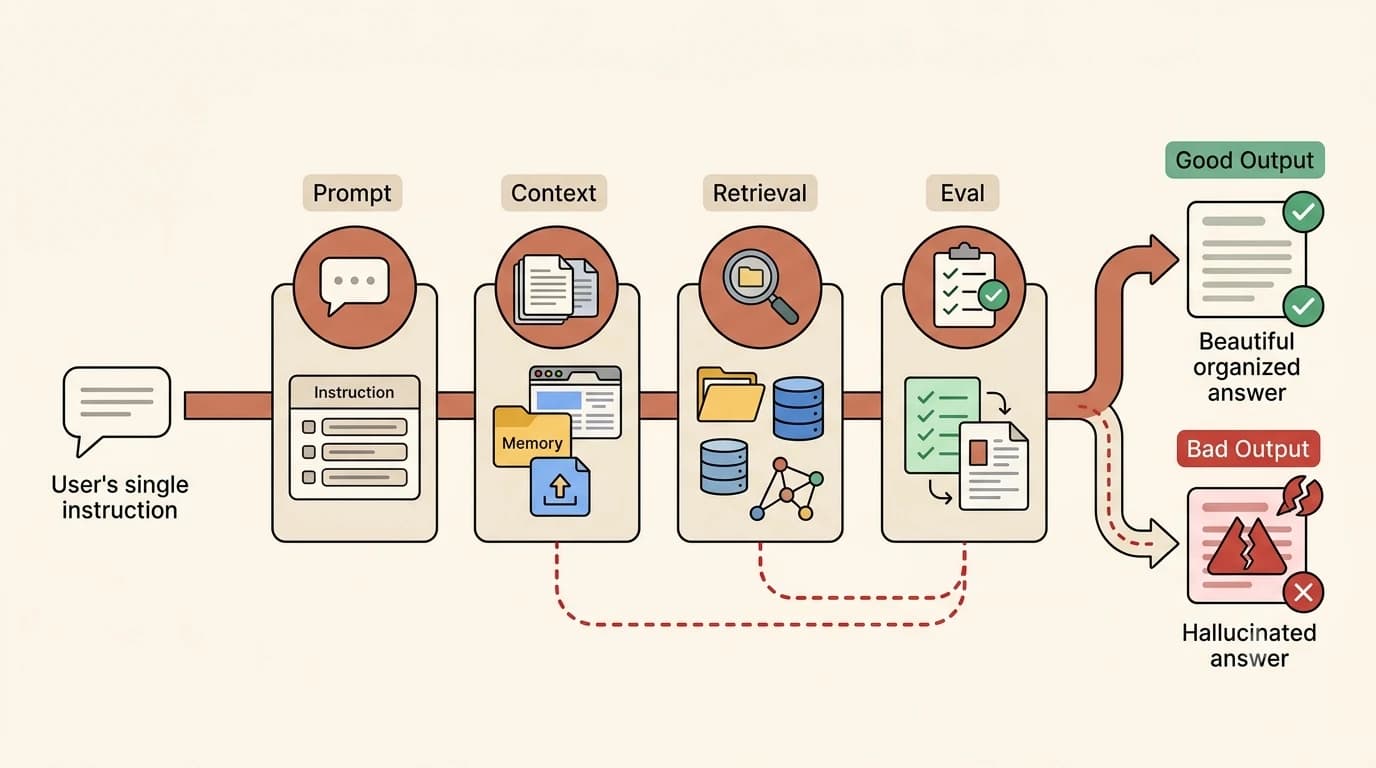
- Most "the AI got it wrong" moments break down into one of four causes: a bad prompt, missing context, bad retrieval, or no way to check the answer.
- Learning to tell those four apart is more useful long-term than memorizing any prompt template.
What Is a Prompt, Really?
A prompt is the specific instruction you give an AI model to produce its next response. That's it. It can be one word or a page of instructions, but it's always the thing you typed (or spoke, or uploaded) that the model is reacting to right now.
A prompt usually carries four ingredients, whether you spell them out or not: the task (what you want done), the context (background the model needs), a role or audience (who it should sound like, who it's writing for), and a format (how you want the answer shaped). Leave one out and the model has to guess. Guessing is where most disappointing answers start.
If an answer feels off, reread your prompt and ask which of the four ingredients you left implied instead of stated. That's usually the fastest fix.
Does Prompting Still Matter With Reasoning Models?
Yes, but it changed shape. Reasoning models think through a problem internally before answering, so they need less of the old "think step by step" scaffolding. What they still need, more than ever, is a precise statement of what you actually want.
Older prompting advice spent a lot of effort telling the model how to think. A reasoning model already does extended thinking internally before it writes a word back to you. Padding your prompt with step-by-step instructions it doesn't need can actually slow it down or muddy the ask. The skill shifted from choreographing the model's thinking to being ruthlessly clear about the task, the constraints, and the output format, and then getting out of the way.
I still write my prompts in the same order every time out of habit, task first, then context, then format, and it's saved me more debugging time than any clever phrasing ever has.
Nobody credible argues prompting became irrelevant. What they argue about is whether it grew into something bigger. It did. The day-to-day wording still matters, but the harder problem now is making sure the model has the right information available when you prompt it at all. That's a different skill, covered later in this course.
The Four Ways an AI Answer Can Go Wrong
When an AI gives you a bad answer, the cause almost always falls into one of four buckets. Naming the bucket is the fastest way to actually fix the problem instead of just rephrasing and hoping.
Prompt means your instruction itself was vague, missing a constraint, or asking for two things at once. Context means the model lacked background it needed, like earlier messages, a document, or a fact you assumed it already knew. Retrieval means the model pulled the wrong information from a search, a database, or an uploaded file. Eval means there was no way to check the answer was correct in the first place, so a wrong answer went out the door unnoticed.
The four failure types at a glance
| Failure type | What actually happened | Quick fix |
|---|---|---|
| Prompt | The instruction was vague or bundled two tasks together | Split the ask, state the format explicitly |
| Context | The model never saw the information it needed | Paste or attach the missing background |
| Retrieval | The model grabbed the wrong document or search result | Narrow the search, check the source it used |
| Eval | Nobody checked whether the answer was actually right | Add a verification step before trusting the output |
That contract-summary mistake from the start of this lesson was a context failure: the model was asked to summarize a document it either didn't fully receive or had to guess parts of. No amount of clever wording in the prompt would have fixed a document the model never actually saw in full.
What's Coming Next in This Course
This lesson only covers the prompt itself. The next few modules go deeper into the other three failure types. Context engineering gets its own module because it's usually the bigger lever once you're building anything real. Later still, you'll see how prompting changes again once a model is calling tools and acting on its own inside agentic AI systems, where the model itself decides what to retrieve and when. That shift has its own rules, covered in agentic prompting.
For now, the goal is just to get comfortable telling these four failure types apart. Everything after this lesson builds on that.
Prefer a visual recap? Here's the whole lesson as a slide deck.
Your Task
Label five failure cases
Read each scenario below and label it prompt, context, retrieval, or eval. Write your answer next to each one before checking yourself.
- You ask a model to "make this better" with no other instruction, and get a generic rewrite that misses what you actually wanted changed.
- You ask a coding assistant to fix a bug, but never show it the error message or the file it's in.
- A support bot answers a question about your refund policy using an old version of the policy page instead of the current one.
- A model gives you a confident, detailed answer to a math question, and nobody on your team double-checks the arithmetic before it ships to a customer.
- You ask for "a summary in the style we usually use" without ever telling the model what that style is.
Answers: 1) prompt, 2) context, 3) retrieval, 4) eval, 5) prompt (a role/format ingredient was left implied instead of stated).
Quick check: prompt, context, retrieval, or eval?
A model writes a confident answer using a competitor's outdated pricing page instead of the current one. What kind of failure is this?
You ask an AI to 'write something for our newsletter' with no topic, audience, or length specified. What's the most likely failure type?
An AI-generated legal summary ships to a client with a factual error nobody caught before sending it. What failure type let that happen?
Done? You've completed Lesson 11.01.
FAQ