RAG-Aware Prompting: How to Keep AI Answers Grounded
RAG-aware prompting means writing instructions that ground AI answers in your documents instead of letting the model guess when it doesn't know.

You paste your whole knowledge base into the prompt, ask a question you know the answer to, and the model gives you something fluent, confident, and wrong. You go back and check. The fact is right there, sitting in the middle of the fifth document, exactly where you put it.
RAG-aware prompting is how you stop that from happening. It means two things: keep the model glued to your documents instead of guessing, and beat the fact that models pay less attention to whatever's buried in the middle of a long prompt. Get both right and retrieval-augmented answers stop being a coin flip.
Key Takeaways
- RAG-aware prompting has two separate jobs: grounding the model to your documents, and structuring those documents so the answer doesn't get lost.
- A model can generate a citation next to a claim without that citation actually supporting the claim. Citations aren't proof.
- Explicit fallback instructions ("say so if it's not in the context") stop a model from quietly guessing when retrieval comes up short.
- Position matters: put your most relevant chunk first or last, not buried in the middle of a long stack.
- Four to eight well-ranked chunks beats twenty loosely-relevant ones.
What Is the "Lost in the Middle" Problem?
The lost-in-the-middle problem is a model's tendency to recall information at the start and end of a long prompt far better than information sitting in the middle. Recall follows a U-shape: strong, weak, strong, not a flat line across the whole context.
Context engineering covers why this happens at the token-budget level. For RAG specifically, it means the exact document your retrieval step correctly found can still get ignored, just because of where it landed in the stack you handed the model.
Researchers behind the original lost-in-the-middle study found this pattern held across multiple model families, not one buggy release. It's a structural attention effect, not a one-off glitch you'll patch by switching models.
A bigger context window doesn't fix this. It just gives the model more middle to lose things in.
Why Grounding Instructions Matter More Than Retrieval Itself
Retrieval can do its job perfectly, hand the model exactly the right document, and the model can still answer wrong. That happens when it blends the retrieved fact with something from its training data and states the blend as one confident answer. Nothing in the output signals that a guess snuck in.
This is where a real misconception trips people up: seeing a citation next to an answer feels like proof. It isn't. A model can generate a citation and a claim in the same pass without ever checking that the citation actually backs the claim. One study found up to 57 percent of citations in RAG-attributed answers weren't actually faithful to the source they pointed to. The citation and the accuracy are two separate things, and only one of them is guaranteed by default.
I used to take a cited answer at face value and move on. The habit that actually caught the bad ones: open the passage the citation points to and read the specific sentence it's supposedly quoting. More than once, that sentence said something adjacent to the claim, not the claim itself.
Skip explicit grounding instructions, and you're trusting the model to police itself on this. It won't, reliably.
A RAG-Aware Prompting Template You Can Copy
Here's an instruction block you can drop directly above your retrieved context:
Answer only using the information in the CONTEXT section below.
If the answer isn't in the context, say "I don't have enough information to answer that" instead of guessing.
When you make a claim, note which passage number it came from.

CONTEXT:
[retrieved chunks go here]

QUESTION:
[user's question goes here]
Three things are doing the work here: the block, the fallback, and the receipt. "Answer only using" blocks the model from quietly reaching into training data. The explicit "say so" fallback gives it permission to admit a gap instead of papering over it. Asking for a passage number gives you something concrete to spot-check, rather than a citation you have to trust blindly.
Leave any one of those three out and the failure mode comes back quietly: no error, no warning, just an answer that sounds exactly as confident whether it's grounded or guessed.
Structuring Documents to Beat Position Bias
Grounding instructions tell the model what to do. Where you place the documents determines whether it can actually do it. This is the long-context handling side of prompting over documents: position matters as much as content.
Say your retrieval step returns five chunks, ranked by relevance, and you dump them into the prompt in that order: most relevant chunk first, followed by four progressively less useful ones. The model reads the top chunk clearly, and by the time it reaches chunk five, buried mid-stack, attention has thinned out. Now flip it. Move your single most relevant chunk to the very front, or duplicate it at both the front and the end. Drop anything you're not confident is useful. Same underlying information, meaningfully different odds the model actually uses it.
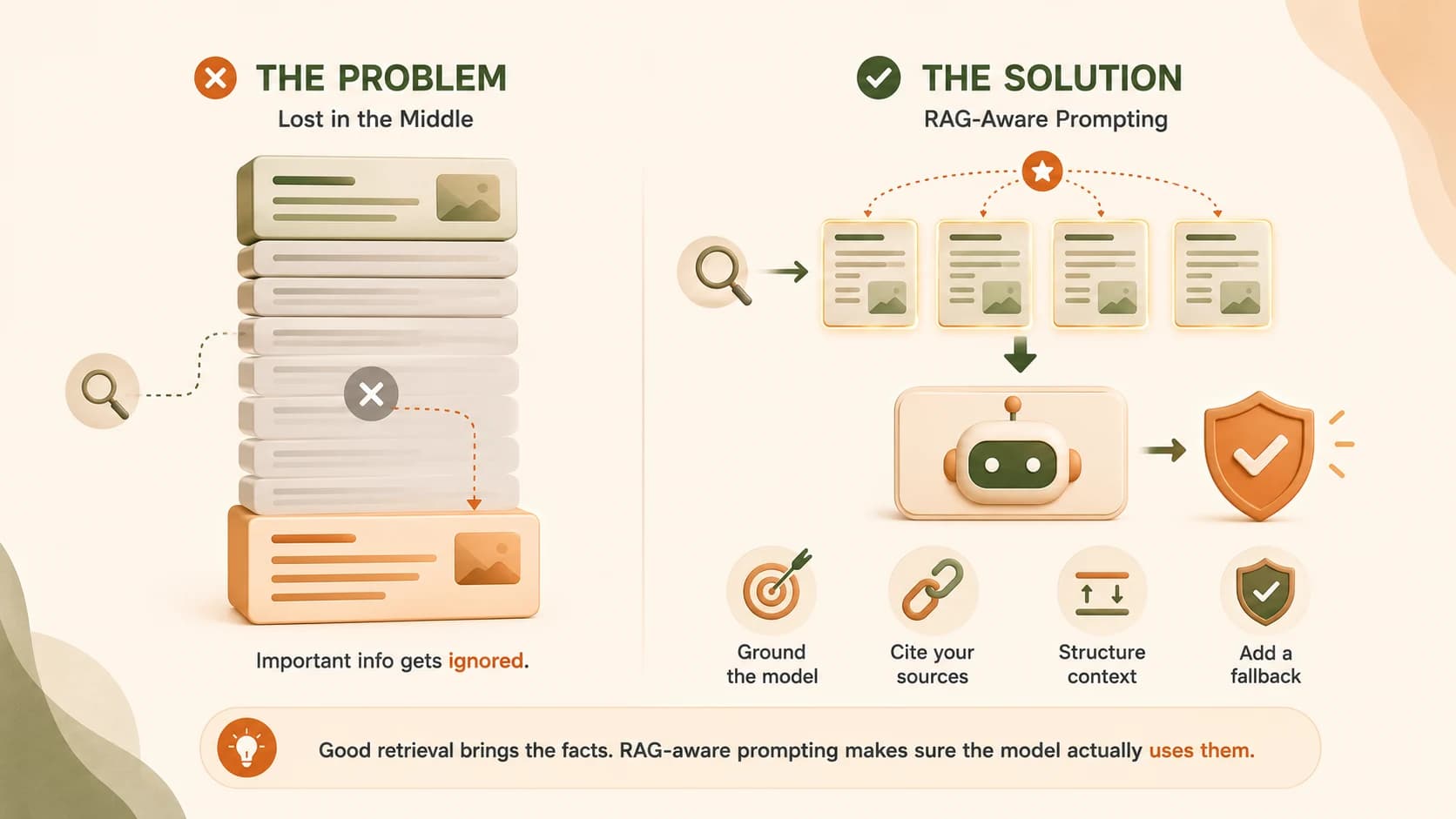
This is the same instinct behind reducing hallucinations: a model grounded in the right evidence, placed where it can actually see it, has far less room to improvise.
If your retrieval step returns more than eight or so chunks, that's usually a sign to re-rank and cut, not to pass all of them through. Fewer, better-placed chunks beat a wide dump every time.
Your Task
Write your own grounding instruction
Take the template from above and adapt it to a real question you'd ask an AI tool (any chat AI works, ChatGPT, Claude, whatever you normally use) about a document you have (an email thread, a set of notes, anything with more than one fact in it).
Run it with a deliberately reordered stack
Paste in two or three source passages, but put the one that actually answers your question in the middle of the stack instead of first. Ask your question and read the answer closely.
Reorder and compare
Move that same passage to the front, run the identical question again, and compare the two answers. Write one line noting which run was more accurate and why you think so.
Done? You've completed Lesson 12.07 and tested position bias on your own documents.
FAQ