What Is RLHF? How AI Models Get Trained to Be Helpful
RLHF is how a raw AI model gets shaped into a helpful assistant. Here's what changes, in plain English, no PPO math required.

A raw, freshly trained language model isn't the polite, helpful assistant you're used to talking to. Left alone, it just predicts plausible next text, sometimes useful, sometimes rambling, sometimes genuinely unhelpful or off-putting. RLHF (reinforcement learning from human feedback) is the training step that turns that raw prediction engine into something that actually behaves like a helpful assistant.
If you haven't covered what a large language model actually is yet, start there first.
Key Takeaways
- RLHF trains a model using human preferences, not just examples, to shape tone, helpfulness, and format
- It's the reason a raw base model and the polished assistant you actually use feel so different
- RLHF shapes how a model behaves, it doesn't make it more factually accurate, those are separate problems
- RLHF is one specific fine-tuning technique, not a separate category from fine-tuning itself
- DPO is a newer, simpler alternative that aims at the same goal without a separate reward model
What Is RLHF?
Reinforcement learning from human feedback (RLHF) is a training technique that uses human preferences, not just labeled examples, to steer a model's behavior. Rather than showing the model a fixed set of correct answers, RLHF shows it multiple possible responses and lets human raters indicate which ones they prefer. The model then gets refined to prioritize the responses humans favored, shifting its behavior toward what people actually chose.
Pretraining teaches a model what's statistically probable in language. RLHF teaches it something different: what's actually helpful, appropriate, and preferred, which pretraining alone never captures.
How It Actually Works
The process starts with a base model that already works. It's been trained on massive amounts of text to predict plausible language. From there, RLHF adds a layer on top, in three rough stages.
How RLHF trains a model, in three stages
| Stage | What happens |
|---|---|
| 1. Generate | The model produces several different responses to the same prompt |
| 2. Rank | Human raters review those responses and rank them by preference |
| 3. Retrain | That ranking data shifts the model toward the kind of responses people consistently preferred |
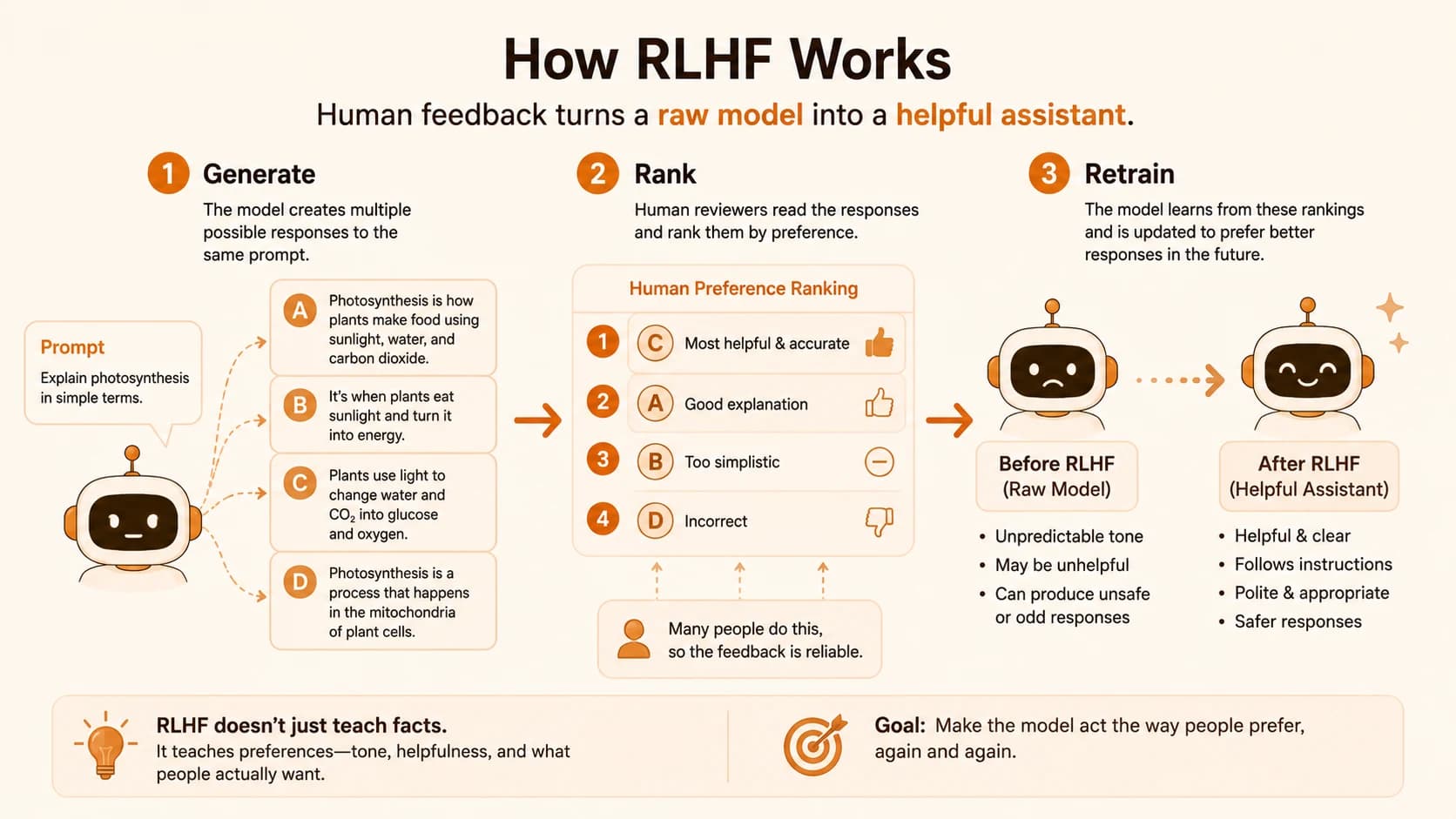
You don't need to understand the underlying optimization algorithm to grasp what RLHF does. The practical version is: humans said "this response is better than that one," repeatedly, at scale, and the model absorbed that pattern.
What RLHF Changes (and What It Doesn't)
RLHF is why a raw model and a polished assistant behave so differently. It's a big part of why a model refuses harmful requests, follows multistep instructions more reliably, and defaults to a tone that reads as considerate rather than blunt or robotic.
What it doesn't do is make the model more factually accurate. RLHF optimizes for what humans rated as a good response. That's about tone, helpfulness, and appropriateness, not verified truth. A model can be extremely well-shaped by RLHF and still confidently produce hallucinations. Those are two separate properties. Two separate mechanisms fix them. Conflating them is a common mistake.
RLHF vs Fine-Tuning: How They Relate
RLHF isn't a separate category from fine-tuning, it's a specific technique within it. Fine-tuning broadly means additional training on top of a base model to change its behavior. RLHF is one particular way of doing that: instead of training directly on fixed example pairs, it trains on human preference rankings between multiple candidate responses.
A newer approach called DPO (Direct Preference Optimization) aims at the same goal, aligning a model with human preferences, using a simpler process that skips training a separate reward model. It's worth recognizing the term if you keep reading in this space, even though the practical difference doesn't change what you need to know as a user of these models.
FAQ