What Is a Transformer Model? The Idea Behind Every LLM
A transformer is the neural network design behind GPT, Claude, and Gemini. Here's what self-attention actually does, without the math.
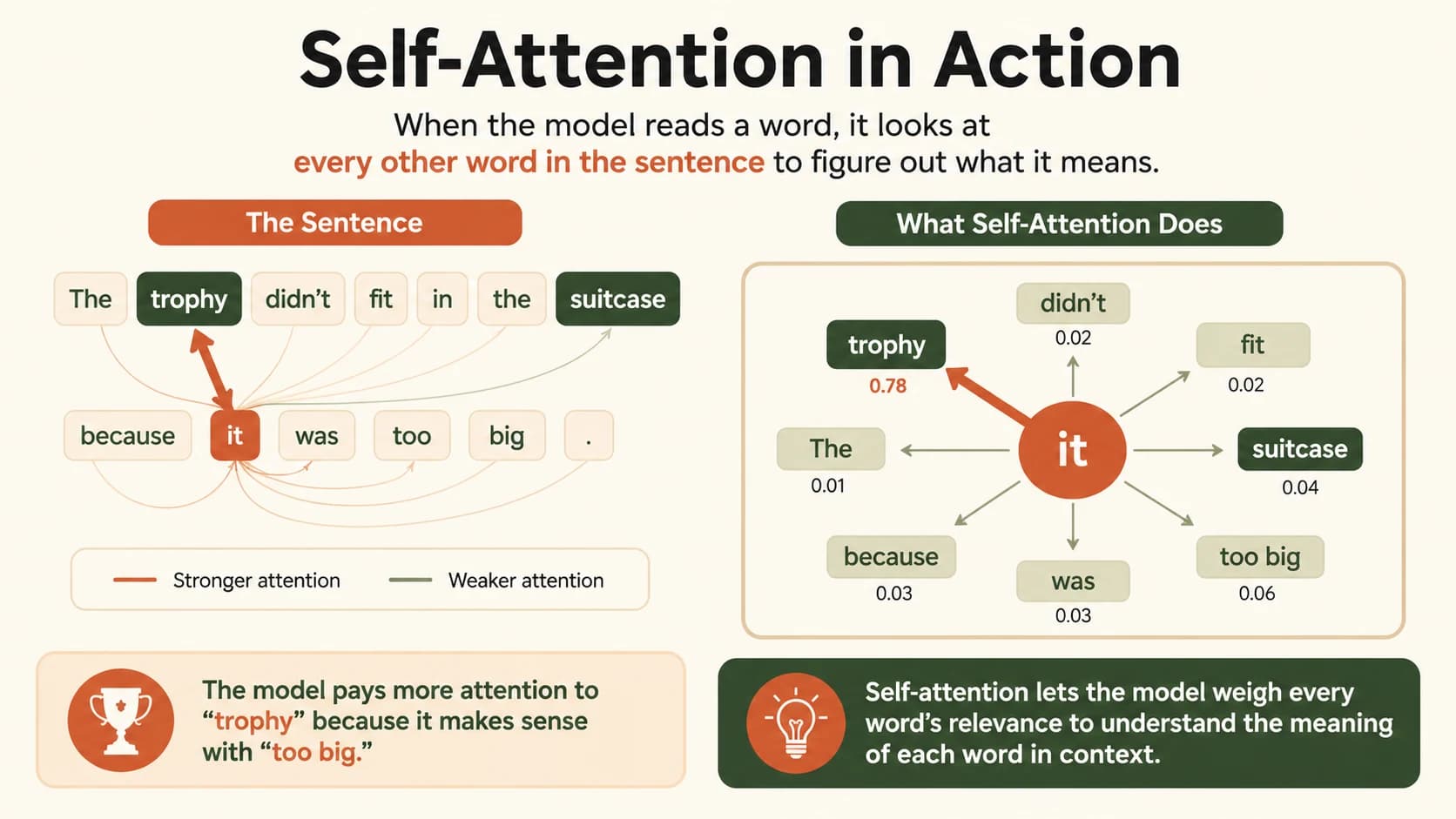
"The trophy didn't fit in the suitcase because it was too big." Read that sentence and you instantly know "it" means the trophy, not the suitcase. An AI model figures out the same thing using a mechanism called self-attention, the core idea inside the transformer, the neural network architecture that powers nearly every large language model you use today, including GPT, Claude, and Gemini.
If you haven't covered what a large language model actually is yet, start there first.
Key Takeaways
- A transformer is the neural network architecture behind almost every modern LLM, introduced in a 2017 research paper
- Its key idea is self-attention: weighing how relevant every other word in the input is to understanding each word, all at once
- That's what lets a model resolve ambiguous references correctly, like knowing what "it" refers to in a long sentence
- Transformers process an entire input in parallel instead of word by word, which is why they train so much faster than older architectures
- You don't need to understand this to use AI tools well, but it explains a lot about why they behave the way they do
What Is a Transformer Model?
A transformer is a type of neural network architecture, first introduced in a 2017 research paper, that became the foundation for nearly every major AI breakthrough since. GPT, Claude, Gemini, and most other large language models are all built on this same underlying design.
For the short version of this definition, see the transformer glossary entry.
The Key Idea: Self-Attention
The breakthrough inside a transformer is called self-attention. When the model processes a word, it doesn't just look at the words immediately next to it. It weighs the relevance of every other word in the input at the same time, and uses that weighing to figure out what each word actually means in context.
Go back to the trophy and the suitcase. A model reading that sentence has to figure out what "it" refers to. Self-attention lets it look across the whole sentence at once. It notices that "too big" connects logically to the trophy not fitting. So it weights "trophy" heavily when resolving what "it" means. No single nearby word gives that away. It takes the whole sentence, considered together.
This connects directly to how LLMs predict text one token at a time. Self-attention is what lets each prediction take the full context into account, not just the last few words. Every token the model reads gets weighed against every other token first. Only then does the model decide what comes next.
Why This Beat Earlier Architectures
Before transformers, language models mostly used architectures called RNNs that processed text one word at a time, in strict sequence. That made two things hard. Capturing a relationship between words that were far apart in a sentence. And training quickly, since each word had to wait for the one before it to finish processing.
Transformers process an entire input in parallel instead. Every word's relationship to every other word gets calculated at the same time, not one at a time in order.
Transformers vs. the older RNN approach
| RNN (older approach) | Transformer | |
|---|---|---|
| Processes text | One word at a time, in order | All words at once, in parallel |
| Long-range relationships | Struggles, distant words fade | Handles well, every word sees every other |
| Training speed | Slow, each step waits on the last | Fast, modern hardware runs it in parallel |
That parallel design is a much better fit for modern hardware built to run many calculations at once. It's a big part of why transformer-based models could be trained on such enormous datasets in the first place.
You don't need to memorize the difference between architectures to work with AI. The practical takeaway is simpler: transformers are why today's models handle long documents and long conversations far better than the generation of AI that came before them.
What This Means for the Models You Actually Use
Understanding transformers explains several things about the tools you already use, even if you never think about the architecture directly. It's why a model can reference something from early in a long document. It's why fine-tuning a model efficiently for a specific task is possible at all, transformers are compatible with training techniques that adjust their behavior without retraining everything from scratch. And it's part of why running these models is computationally expensive, weighing every word against every other word takes real processing power, especially as the input gets longer.
None of this changes how you'd use ChatGPT or Claude day to day. But the next time a model handles a genuinely long, complicated piece of text without losing the thread, that's self-attention doing its job.
FAQ