RAG vs Fine-Tuning: Which Does Your AI Actually Need?
RAG handles knowledge that changes, fine-tuning handles behavior that shouldn't. Here's how to tell which one your project actually needs.

A support chatbot confidently quotes last year's refund policy. A second chatbot gives technically correct answers in a tone that makes every customer feel like they're reading a legal filing. Both are real failures, and they need two completely different fixes: retrieval-augmented generation (RAG) for the first, fine-tuning for the second.
If you're not sure what a large language model is doing under the hood before this comparison, start with what an LLM actually is.
Key Takeaways
- RAG fixes stale or missing knowledge by retrieving real documents at query time; fine-tuning fixes inconsistent behavior by retraining on examples
- RAG is cheap and fast to update; fine-tuning is expensive and slow to update, that asymmetry decides most real-world choices
- Fine-tuning rarely makes a model know new facts reliably, it's much better at teaching tone, format, and style
- The two are not competitors, production systems increasingly use both together
- If your data changes weekly or daily, that alone is often reason enough to reach for RAG first
RAG vs Fine-Tuning: The One-Sentence Version
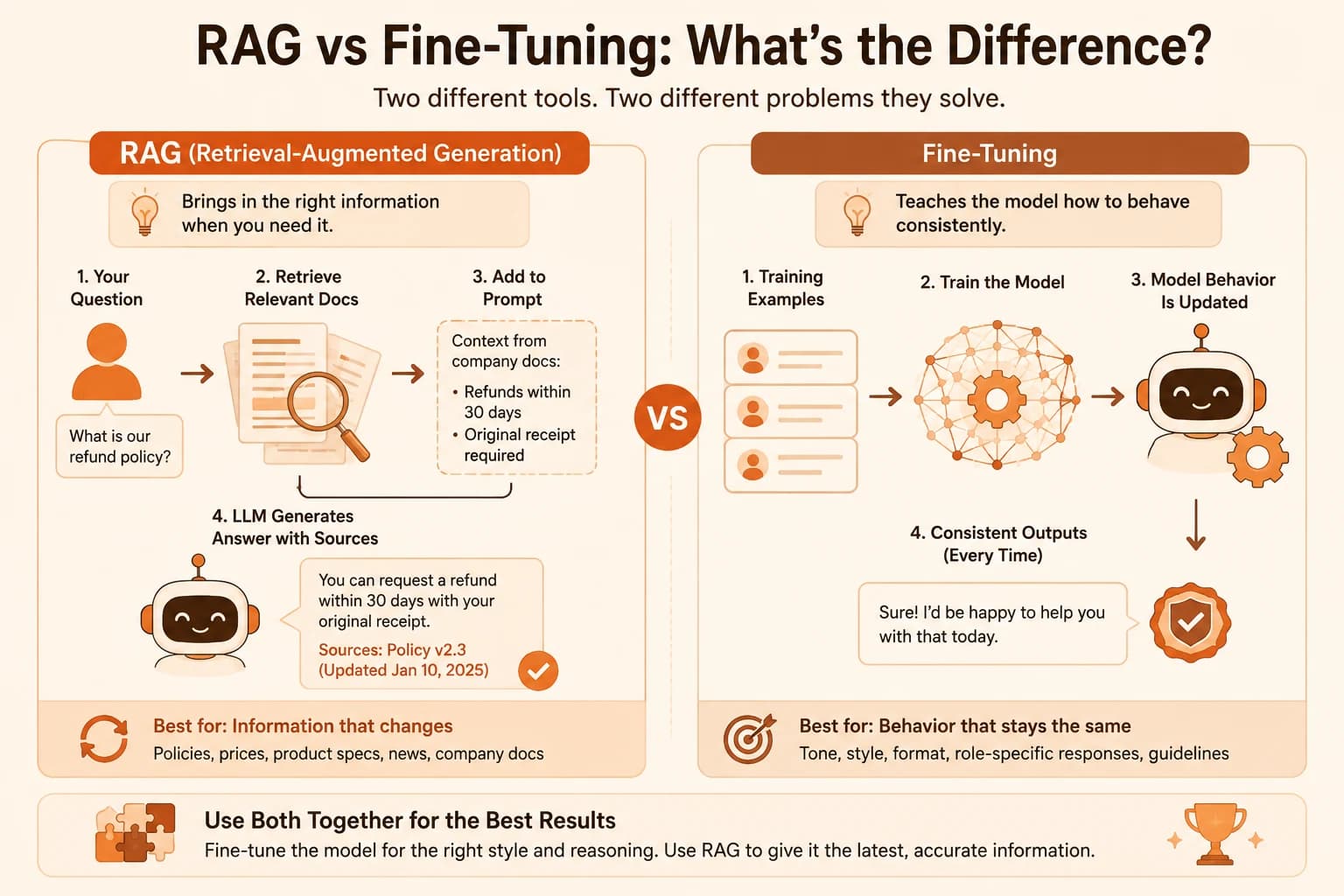
Here's the framing that actually matters, stripped of the feature tables: RAG handles knowledge that changes. Fine-tuning handles behavior that shouldn't.
RAG doesn't touch the model at all. It retrieves real documents, the quick RAG definition covers the mechanics, and hands them to the model as context right before it answers. Fine-tuning does the opposite: it adjusts the model's actual parameters through additional training, covered in full here, so its behavior shifts permanently.
That single distinction, knowledge versus behavior, resolves most "which one do I need" questions faster than any comparison chart.
When RAG Is the Right Call
RAG wins whenever the answer depends on something that can change: prices, policies, product specs, support tickets, this morning's news. It also wins whenever you need to show where an answer came from, which matters if anyone is going to ask "how do you know that."
Picture a company handbook chatbot. The vacation policy gets updated every January. With RAG, you edit one document and the chatbot's next answer reflects it immediately.
There's no retraining, no waiting, no redeploying a model. Teams that switch to RAG for this exact reason report update latency dropping from weeks to minutes. That gap only grows the more often your source material changes. If you want the deeper mechanics of exactly how that retrieval step works, how embeddings and vector stores make RAG work covers it in full.
When Fine-Tuning Is the Right Call
Fine-tuning wins when the problem isn't missing knowledge, it's inconsistent behavior. You need a specific tone every time. You need output in a rigid format a prompt keeps failing to enforce. You're running the same narrow task millions of times and want a smaller, cheaper model that's been trained to do exactly that one thing well.
Picture a legal-summary tool that keeps drifting into casual phrasing no matter how the prompt is worded. Fine-tuning on hundreds of examples of the exact tone you want steers the model's actual behavior, not just this one response, every response going forward. That's a different kind of fix than handing it a better document. For the underlying mechanism of how a model absorbs that kind of retraining, how LLMs learn in the first place is the place to start.
Fine-tuning can technically expose a model to new facts during training, but it's a poor tool for the job. Models are much more reliable at absorbing style and format from fine-tuning examples than at reliably memorizing and recalling specific facts from them. If the goal is fresh knowledge, reach for RAG first.
Where Each One Fails You
This is the part most comparison pages skip, and it's the part that actually saves you a wasted project.
RAG fails when the retrieval step itself is bad: irrelevant documents get pulled in, the model gets confused by conflicting passages, or the knowledge base is disorganized enough that "relevant" and "retrieved" stop meaning the same thing. RAG also can't fix a model that fundamentally can't follow instructions or reason well. It only adds facts, it doesn't improve the reasoning wrapped around them.
Fine-tuning fails just as visibly in the other direction. Train on too little data, or data that's inconsistent in quality, and you get a model that's confidently worse, not better. Fine-tuning also locks in whatever's in the training set at that moment, so a model fine-tuned on last quarter's product line will happily give confident, wrong answers about a discontinued product unless someone retrains it again.
Neither approach forgives sloppy inputs. RAG amplifies bad retrieval. Fine-tuning amplifies bad examples.
Can You Use Both?
Yes, and at real production scale this is usually the answer that wins. Fine-tune the model so it reliably reasons and responds in the exact style, format, and domain vocabulary your task needs. Then layer RAG on top so it always has the freshest facts to reason over.
A medical assistant tool is the clearest version of this. Fine-tune the base model on medical terminology and diagnostic reasoning so it "thinks" like a clinician. Then use RAG to pull in a specific patient's current chart or this month's research, information that changes constantly and could never live inside a fine-tuned model's frozen parameters. Neither piece alone gets you there.
A Quick Decision Checklist
Which one do you actually need?
| Your situation | Reach for |
|---|---|
| Answer depends on data that changes (prices, docs, tickets) | RAG |
| Need to show sources or pass an audit | RAG |
| Need a consistent tone, style, or output format | Fine-tuning |
| Running a narrow task at very high volume | Fine-tuning |
| Need both fresh facts and consistent behavior | Both, fine-tune for behavior, RAG for freshness |
| Data changes weekly or faster | RAG, fine-tuning update cycles can't keep pace |
I've watched teams reach for fine-tuning first because it sounds like the "serious" option, then spend weeks retraining to keep pace with data that RAG would have handled with a document edit. Start with the checklist above before the tooling decision, not after.
The Two-Question Gut Check
If the checklist above still feels abstract, two questions usually settle it faster than any table.
First: if this information changed tomorrow, would my system need to know within minutes, or could it wait weeks? An answer of "minutes" points straight at RAG. Retraining on a schedule that tight isn't realistic for almost any team.
Second: is the problem that the model doesn't know something, or that it knows the right thing but says it wrong? Missing knowledge points to RAG. Wrong tone, wrong format, or inconsistent reasoning points to fine-tuning, no amount of better retrieval fixes a model that answers correctly but sounds nothing like your brand.
Most real projects answer "both" eventually, which is exactly why the hybrid pattern above keeps showing up in production systems rather than staying a theoretical option.
FAQ