AI Hallucination Explained: Why Models Guess Confidently
AI hallucination is when a model states false information as confidently as true information. Here's why it happens and how to catch it.

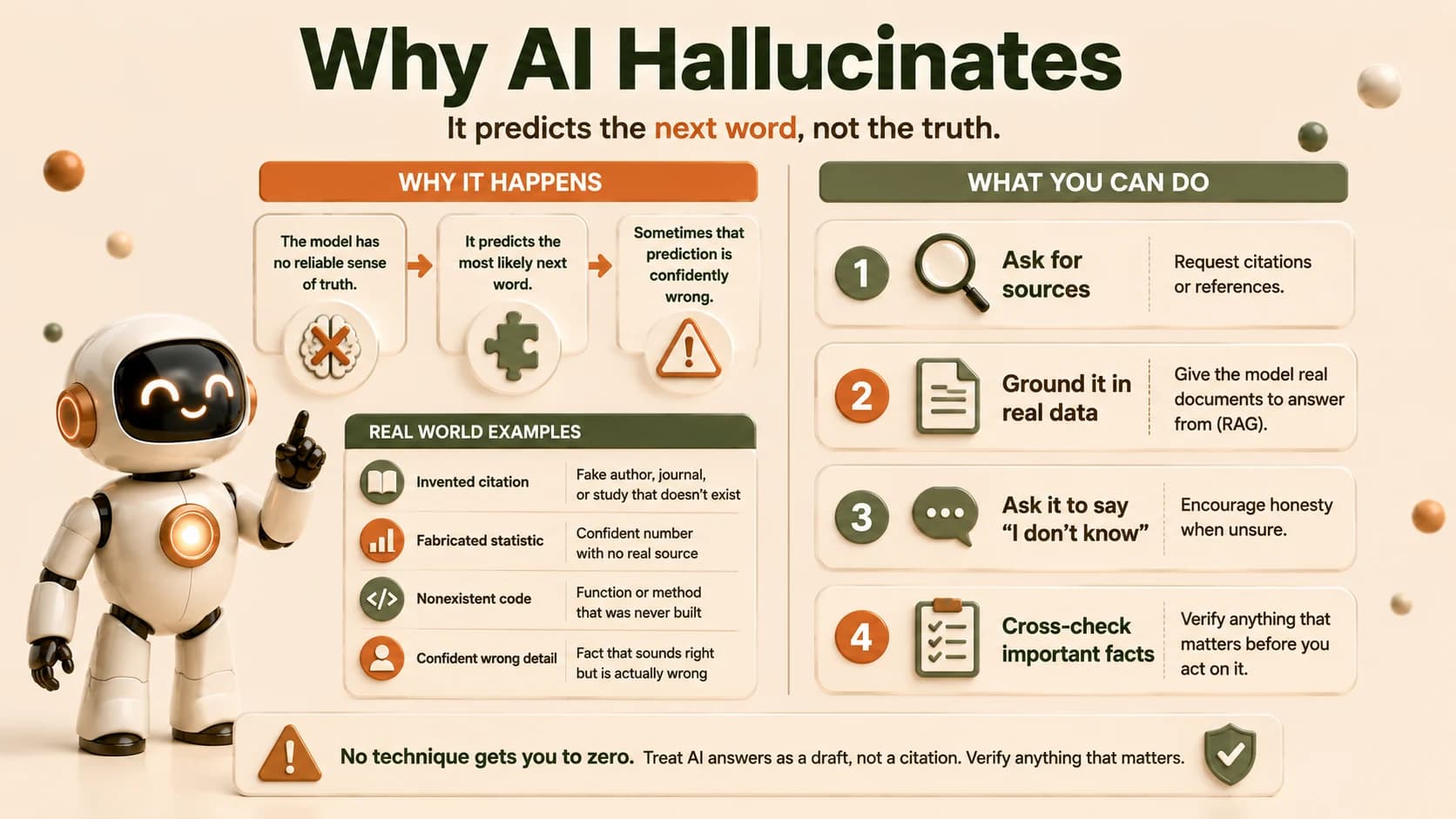
You ask an AI model for a source to back up a claim, and it gives you one: an author, a year, a journal name. It reads like a real citation. It isn't. The study doesn't exist. This is hallucination: when an AI model states false or fabricated information with exactly the same confidence it uses for true information.
If you haven't covered what a large language model actually is yet, start there first.
Key Takeaways
- Hallucination is confidently stated false information, not a hedge, not a guess with a caveat, stated as plainly as fact
- It happens partly because training and evaluation methods reward a confident answer over an honest "I don't know," the same incentive as a penalized-guessing multiple-choice test
- It's not lying, the model has no concept of truth to knowingly contradict
- It's most common on obscure facts, recent events, or narrow technical details where training data was thin
- Grounding answers in real documents cuts it sharply, but verifying anything that matters is still the safest habit
What Is Hallucination in AI?
Hallucination is when a model generates text that sounds fluent and plausible but is factually wrong, invented, or unsupported, delivered with no hedge, no uncertainty, no indication anything is off. Classic examples: a nonexistent court case with realistic-sounding citations, a historical date that's confidently off by decades, or an API function that was never actually part of the library.
The model isn't flagging low confidence because it doesn't have a reliable internal sense of "I don't actually know this." It just generates the most statistically likely next piece of text, whether or not that text corresponds to anything real.
For the short version of this definition, see the hallucination glossary entry.
Why It Happens: The Test-Taking Incentive
The usual explanation, "it just predicts patterns," is true but incomplete. It doesn't explain why the wrong answers come out so confident instead of hedged.
Part of the real answer is more specific: the way models get trained and evaluated actively rewards confident guessing over admitting uncertainty. Picture a multiple-choice test. It penalizes wrong answers but gives zero credit for leaving a question blank. Under those rules, guessing beats staying silent, even when you're not sure.
Many of the benchmarks used to train and score language models work the same way. They reward a confident answer. They give no credit for an honest "I don't know." Over enough training, that pushes the model toward guessing rather than admitting a gap.
This connects to how LLMs predict text one token at a time. The mechanism that makes hallucination possible is the same mechanism that makes any response possible at all. There's no separate fact-checking step built in. Just prediction, shaped by incentives that reward confidence.
What Hallucination Looks Like in Practice
Hallucination shows up in recognizable patterns once you know to look for them.
Common hallucination patterns
| Pattern | What it looks like |
|---|---|
| Invented citation | A real-sounding author, journal, and year that don't actually exist |
| Fabricated statistic | A specific number stated with confidence, with no real source behind it |
| Nonexistent code | A function or library method that sounds plausible but was never implemented |
| Confident wrong detail | A historical or biographical fact that's close to true but wrong in a specific way |
None of these come with a warning label. That's the real danger. Every source of information is sometimes wrong. This one is wrong in exactly the same tone it uses when it's right.
Is It the Same as Lying?
No, and the distinction matters for how you should react to it. Lying requires knowing the truth and choosing to say something else. A model generating a hallucinated answer isn't concealing a truth it secretly knows, it doesn't have a "known truth" to compare its output against in the first place. It's producing the most statistically likely continuation of the text, and sometimes that continuation happens to be false.
I've had a model confidently walk me through a function that simply doesn't exist in a library I use daily, complete with plausible-looking parameters. It wasn't hiding anything. It genuinely had no internal signal that anything was wrong with its answer.
How to Reduce the Risk
You can't eliminate hallucination with a current model, but you can sharply cut how often it happens and how much it costs you when it does. Grounding a model's answer in a real document instead of its memorized training data is one of the most effective fixes, which is the whole idea behind RAG, retrieval gives the model something concrete to reference instead of relying on pattern-matched memory alone.
At the prompt level, evidence-first prompting works the same way on a smaller scale: paste in a real source and require the model to quote from it before answering, which sharply reduces fabrication on anything you can ground in an actual document.
No technique gets you to zero. For anything that actually matters, medical, legal, financial, or anything you'd be embarrassed to have wrong in public, verify it against a real source before you act on it. Treat AI answers as a draft, not a citation.
FAQ