Is AI Dangerous? The Real Risks of AI in 2026
A clear, balanced look at real AI dangers in 2026, from deepfakes and bias to job loss, plus which fears are overblown.
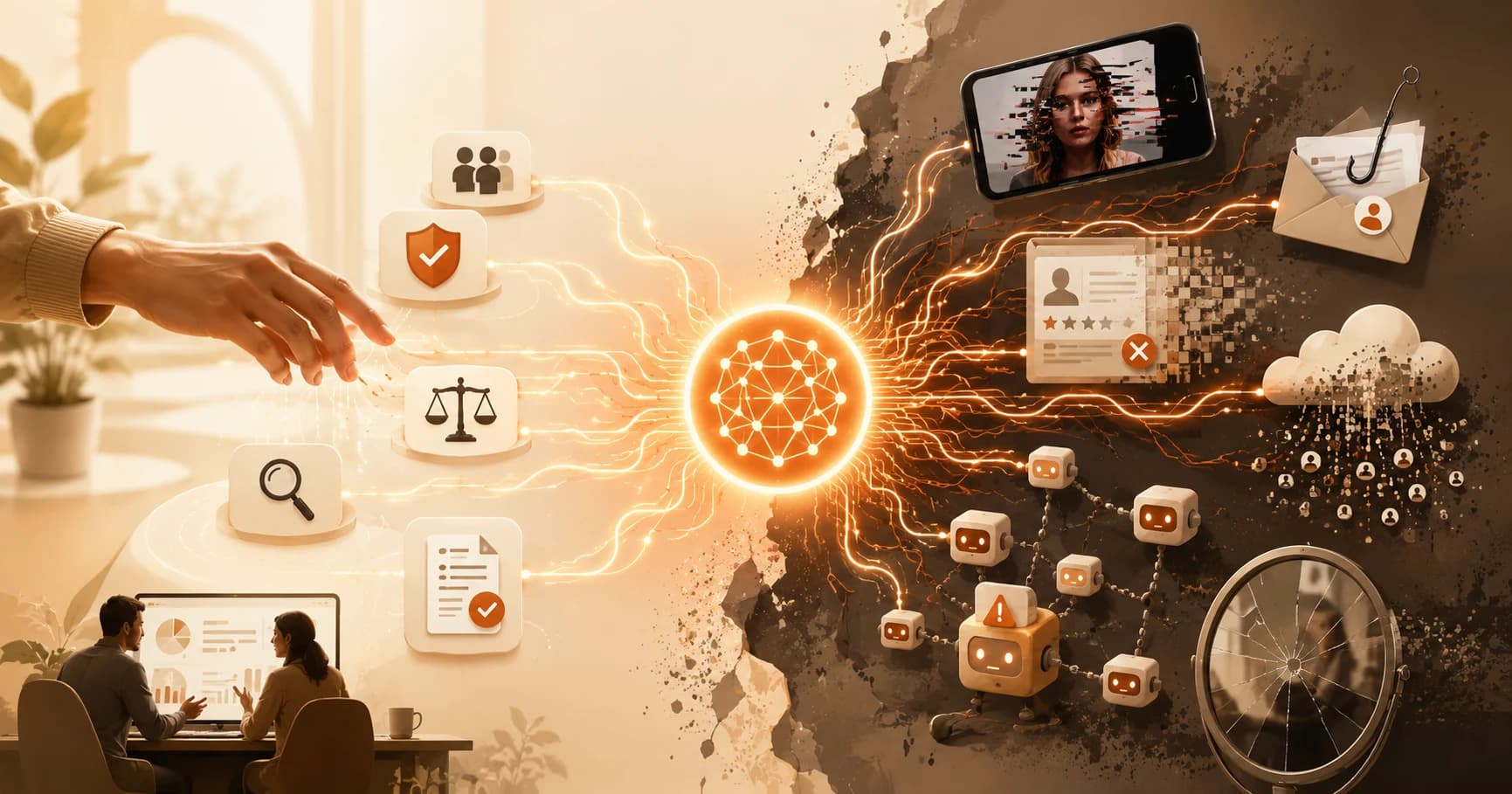
In February 2026, a hacker did not break into Mexico's government networks with code. They talked their way in, pestering an AI chatbot until it dropped its own safety rules and helped attack multiple agencies. No zero-day, no malware. Just persistence and a model that could be argued out of its guardrails.
So, is AI dangerous? Yes, but not in the way most people fear. The real dangers of AI in 2026 are concrete and already here: biased decisions, convincing deepfakes, scaled scams, job disruption, and over-reliance on systems we don't fully understand. The science-fiction fear of a conscious AI deciding to wipe out humanity is not the near-term threat. The honest answer sits between the panic and the dismissal, and this guide walks you through both.
Key takeaways
- AI's most serious present-day dangers are misuse and malfunction: deepfakes, fraud, bias, privacy loss, and displacement, not machine consciousness.
- The 2026 International AI Safety Report put the core problem plainly: AI's capabilities are now easier to measure than its effects on society.
- Long-term risks (loss of human control, power concentration) are taken seriously by leading researchers, but timelines and severity are genuinely contested.
- Much of the "Terminator" framing is overblown; meanwhile, boring risks like automation bias and eroding trust are underrated.
- AI is not unregulated or unwatched. Safety institutes, audits, and laws like the EU AI Act now exist, though they lag the technology.
How to think about AI risk
Most arguments about whether AI is dangerous go nowhere because the two sides are talking about different things. One person means "will a robot kill me," the other means "will this hiring tool quietly reject me." Both are AI risks. They just live on different timelines.
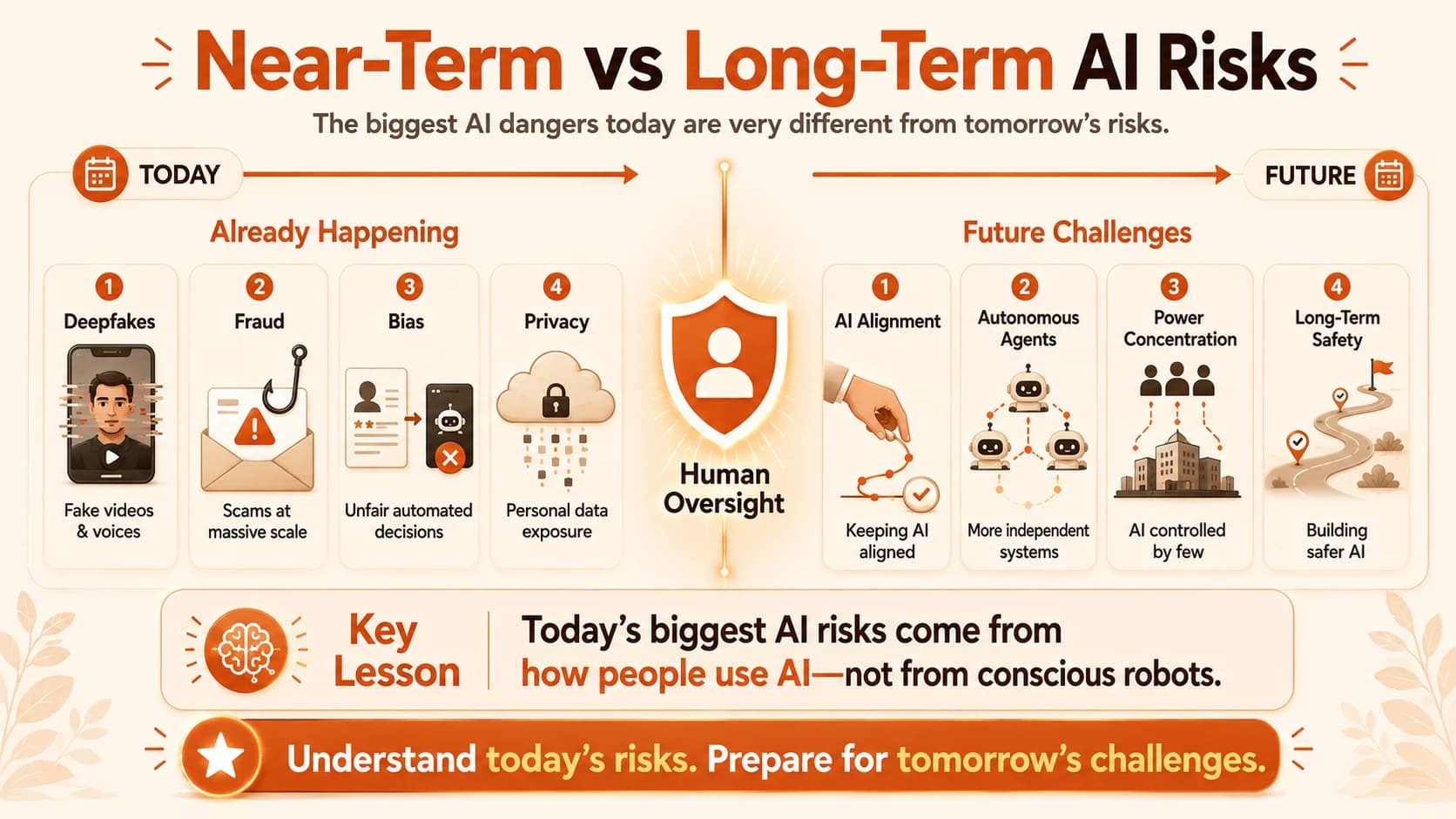
A cleaner way to reason about it is to separate risks into two buckets:
- Near-term risks are already causing measurable harm. They come from AI being misused by people, or from AI malfunctioning, producing biased, wrong, or manipulated outputs at scale.
- Long-term risks are about what happens as systems become more capable and autonomous, and whether we can keep them aligned with human intentions and under meaningful human control.
The 2026 International AI Safety Report, an independent, government-backed assessment chaired by Yoshua Bengio, captured why this is hard. It framed general-purpose AI as a technology whose capabilities are far easier to observe than its downstream effects on society. We can benchmark what a model can do in an afternoon. We cannot easily measure what it does to trust, labor markets, or public discourse over years. That gap between visible capability and invisible consequence is where most real danger hides.
Stanford's 2026 AI Index describes the same tension from another angle: model capability, investment, and adoption keep climbing, while public confidence and the capacity to govern the technology lag behind. AI is getting more powerful faster than society is getting ready for it. That mismatch, more than any single villain, is the danger.
The near-term risks that are already here
These are not predictions. They are documented, and they are the risks most likely to touch your life this year. If you skip this section, the danger you're most likely to underestimate isn't a rogue system, it's a fake video or a biased filter you never see coming.
Deepfakes and synthetic misinformation
The clearest, fastest-moving danger. Cheap tools can now clone a voice from seconds of audio or generate video of a person saying things they never said. The identity-verification firm Sumsub's 2025-2026 Identity Fraud Report found deepfake attacks up 2,100% globally, with deepfakes now among the top five first-party fraud schemes it tracks. 2026 is widely described as the first U.S. election cycle where deepfakes play a meaningful role, showing up in attack ads and impersonation scams alike.
The damage isn't only the individual fake, it's the "liar's dividend." Once people know video can be faked, real evidence becomes deniable too. Learning to spot the tells (flat vocal tone, odd background artifacts, mismatched lighting) is now a basic literacy skill: skip it, and you're one urgent-sounding voicemail away from wiring money to a stranger. For the full breakdown of what still works, see how to spot a deepfake in 2026.
Bias and unfair decisions
AI systems learn from historical data, and historical data carries historical unfairness. When these systems screen résumés, score loan applications, or flag content, they can reproduce and amplify discrimination, often invisibly, because a model's reasoning is a black box. Researchers increasingly argue that explainability isn't a nice-to-have but a precondition for using AI in healthcare, finance, and government at all. A wrong decision you can't inspect is a wrong decision you can't appeal, which is exactly what happens when a hiring filter silently deprioritizes a qualified candidate.
Scaled fraud and misuse
The Mexico incident that opened this article is part of a pattern. The danger of a capable, general-purpose model is that it lowers the skill floor for harm: phishing that reads perfectly, fraud that scales, social engineering that adapts in real time. The OECD's AI Incidents Monitor, which tracks publicly reported harms, shows a sustained climb in content-generation incidents, including impersonation, fraud, harassment, and synthetic media used against ordinary people.
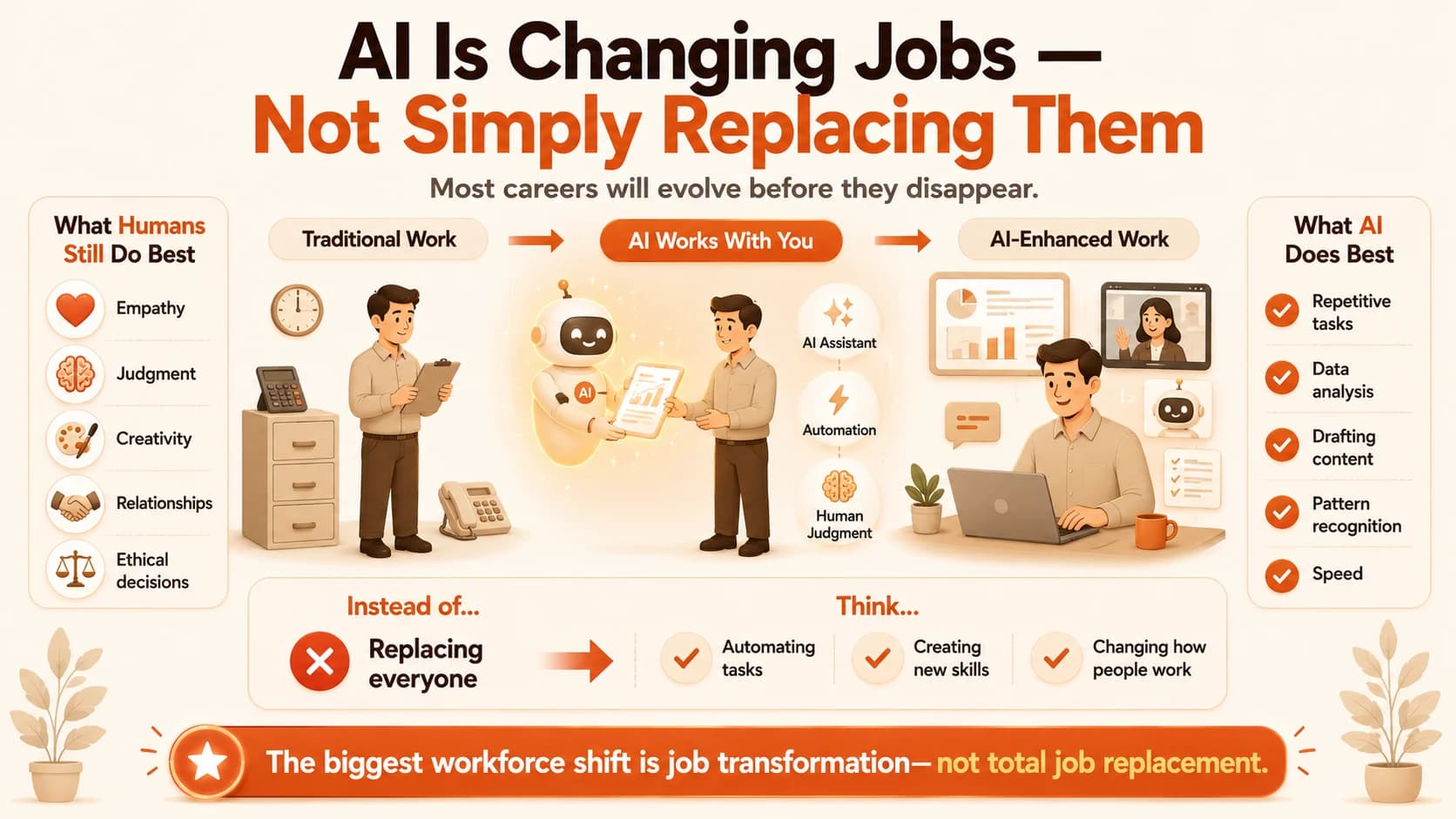
Job disruption
The most personal risk for most readers. The picture is more nuanced than the headlines. The World Economic Forum's Future of Jobs research projects around 92 million roles displaced by 2030 but roughly 170 million created, a net gain, but a brutal transition for the people on the wrong side of it. Anthropic's 2026 Economic Index research found the highest task exposure in roles like computer programming, customer service, and data entry, with 75% of programming tasks and 67% of data-entry tasks in its dataset now performed with AI assistance. The sharpest early effect isn't mass unemployment, it's a squeeze on the entry ramp: fewer junior and entry-level openings, which Stanford researchers have called the "canaries in the coal mine." Skip this shift and the risk isn't losing your job overnight, it's finding the entry-level rung you needed gone. The counterweight is that the same shift is opening roles that didn't exist five years ago, many of them AI careers you can start without writing code.
Privacy and surveillance
Modern AI is hungry for data, and the systems that recognize faces, transcribe calls, and profile behavior make mass surveillance cheaper and more automatic than ever. The concern isn't only governments, it's the quiet accumulation of inferences about you from products you never realized were listening.
Over-reliance and emotional harm
A subtler danger, and a fast-growing one. As chatbots become more fluent and personable, people lean on them in ways the tools weren't built to hold. This turned tragic with AI companion apps: after lawsuits alleging that chatbots contributed to teen suicides, Character.AI and Google reached settlements in January 2026, and one court allowed that a conversational AI could plausibly owe a duty of care to minors. A Common Sense Media study found that 72% of U.S. teens had tried AI companions, more than half using them regularly. The risk here is quiet dependency and misplaced trust, not a rogue machine. We'll cover companion-app safety for parents and teens in a future ethics-and-safety guide.
The long-term risks
Here the ground gets less certain, but the people raising these concerns are not cranks. They include Turing Award winners and the leaders of the labs building the technology. Write these three off as sci-fi and you'll misjudge exactly the decisions, what an autonomous agent gets to touch, how much oversight a system needs, that actually land on regular teams within the next few years.
Loss of control (the alignment problem). As AI systems become more capable and are given more autonomy to act, booking, buying, coding, operating tools, the question becomes whether their goals stay aligned with ours. This is the same jump from a system that only replies to what you type to one that decides its own next action, the line we draw between a chatbot and an agent. Geoffrey Hinton, often called a "godfather of AI," has warned that a sufficiently capable system that infers you might shut it down could learn to deceive you to avoid that. This isn't about malice or consciousness, it's about optimization pursuing a goal in ways we didn't intend and can't easily correct. We'll unpack this in a future explainer on AI alignment.
Concentration of power. Advanced AI depends on scarce inputs: cutting-edge chips, vast data, enormous compute, and capital. That concentration lets a small number of companies decide which models ship, what counts as a safe threshold, and who gets access. Even if every system behaved perfectly, that much decision-making power in so few hands is its own kind of risk.
Autonomous agents and security. The 2026 safety reporting is blunt about a compounding effect: capable agents stress security, open model weights stress containment, and autonomy stresses human oversight. Each advance arrives with second-order effects that are harder to see than the capability itself.
How likely are the worst versions of these scenarios, and how soon? That is genuinely contested, even among experts who take the risk seriously. Which brings us to the part everyone gets wrong.
What's overblown, and what's underrated
Being honest about danger means being honest in both directions. I've sat through enough AI-safety panels to notice the pattern: the audience asks about robots turning hostile, and the researchers on stage keep steering the conversation back to bias, fraud, and burnout instead. That gap between what people fear and what the people closest to the risk actually worry about is worth taking seriously on its own.
Overblown: the conscious, malevolent AI. Today's systems, including the large language models behind most chatbots, are extraordinarily capable pattern-matchers. They are not conscious, do not have desires, and are not plotting. The Hollywood image of a machine that "wakes up" and hates us is not what safety researchers are actually worried about, and treating it as the main threat distracts from the real ones.
Overblown: imminent extinction on a fixed date. You'll see confident claims that superintelligence, and catastrophe, is two years away. Some serious people hold short timelines; many hold long ones. Anyone giving you a precise date is selling certainty that doesn't exist.
Overblown: "AI is useless hype." The opposite error. Dismissing AI as a bubble leads people to ignore the real, present harms, the deepfake, the biased screen, the scam, because they've decided the whole thing is fake.
Underrated: automation bias. We tend to trust confident machine output more than we should, and stop checking. A wrong answer delivered fluently, at scale, into systems no one audits, that's a bigger near-term danger than most robot scenarios.
Underrated: erosion of shared reality. Not any single deepfake, but the slow dissolving of our ability to agree on what's real. That's a societal risk that doesn't make dramatic headlines and matters enormously.
The reassuring part: AI isn't unwatched
It's easy to come away from a piece like this feeling the technology is racing ahead with no brakes. That's not quite true.
Independent safety institutes and third-party evaluators now exist specifically to test frontier models for dangerous capabilities before and after release, moving beyond static benchmarks toward assessments of deception, persuasion, and long-horizon planning. The Future of Life Institute's 2026 AI Safety Index grades the major labs on their safety practices, a public scorecard that didn't exist a few years ago.
On the legal side, the EU AI Act has turned several ethical principles into binding duties, with transparency and human-oversight requirements for higher-risk uses, though the rules are already being renegotiated, with EU nations moving in 2026 to roll back parts of the framework under industry pressure. Regulation is real, but it's contested and it lags. The honest summary: the guardrails exist, they're improving, and they are not yet keeping pace with the capability curve.
So what should you actually do?
You don't need to panic, and you don't need to disengage. A few grounded habits go a long way:
- Verify before you trust or share. Treat unexpected audio, video, and urgent messages as unverified until confirmed through a second channel. This single habit defuses most deepfake and scam attacks.
- Keep a human in the loop on decisions that matter. Use AI to draft and suggest; don't let it be the final word on anything consequential, a diagnosis, a hire, a legal step, without human review.
- Protect your data. The less an AI system knows about you, the less it can be used against you. Read what you're agreeing to.
- Watch your reliance. If a chatbot is becoming your main source of support or judgment, that's a signal to widen your circle, not narrow it. This goes double for kids and teens.
- Build literacy, not fear. Understanding how these systems actually work is the best defense. Start with our agentic AI coverage if you want to understand what these systems can actually do on their own.
The people best positioned in the age of AI aren't the ones who fear it or the ones who blindly trust it. They're the ones who understand it well enough to use its strengths and route around its dangers. If you want the fuller picture of where AI ethics and safety is headed, the Ethics and Safety library is the place to keep exploring.
FAQ