How to Spot a Deepfake in 2026: Signs That Still Work
Deepfakes are nearly impossible to spot by eye in 2026. Learn the verification habits and warning signs that still catch scams and fake videos.
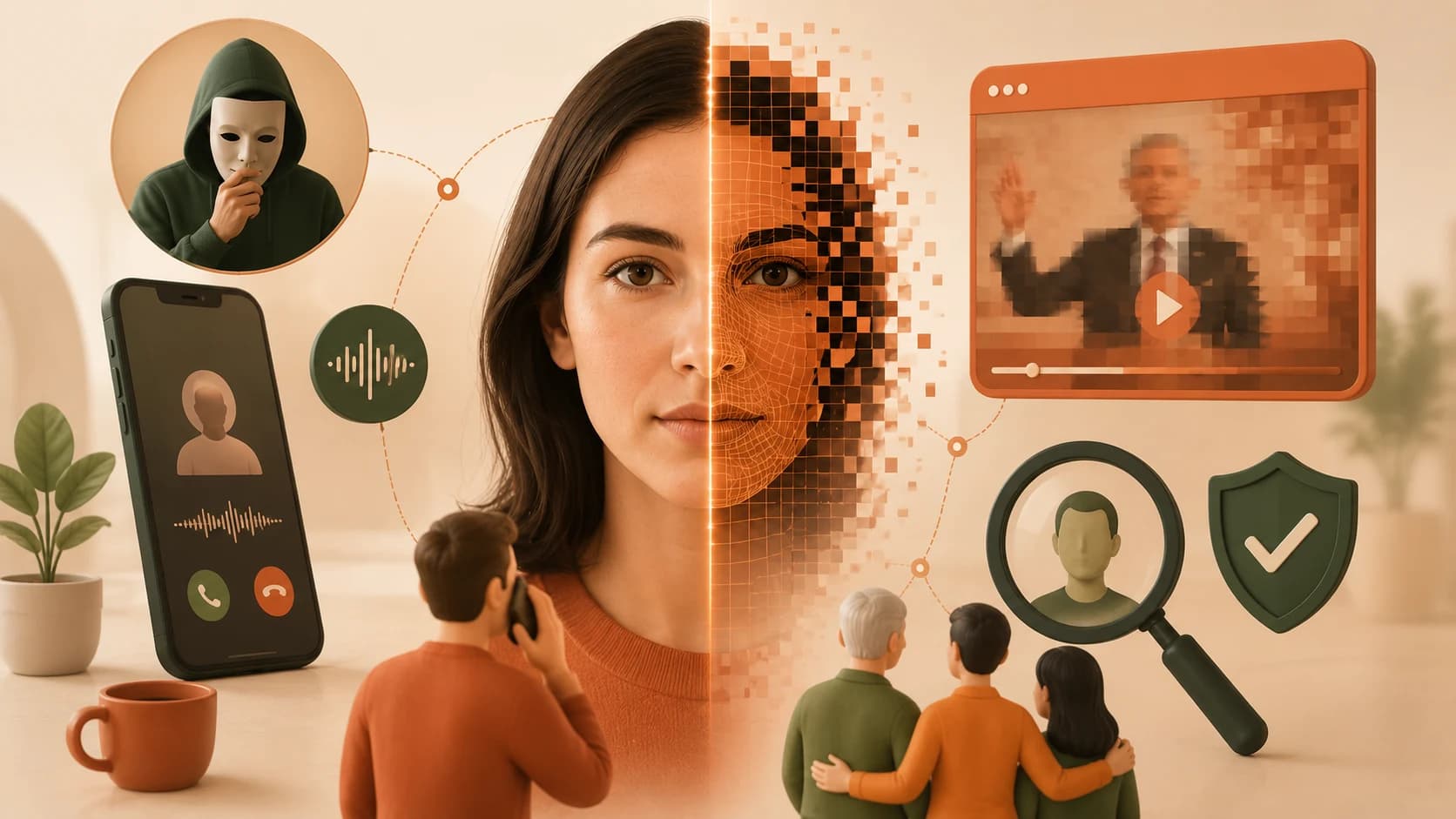
Your phone rings. It's your daughter, crying, saying she's been in an accident and needs money wired right now. The voice is hers, the panic sounds real, and you have about ninety seconds to decide what to do.
In 2026, that call can be entirely fake, and you likely can't tell by ear or eye alone. Studies on human deepfake detection put our accuracy at close to a coin flip, and only a tiny fraction of people can reliably spot a synthetic video or voice on sight. The advice that used to work, watch the blinking, check the teeth, doesn't hold up against today's generators. What still works is a small set of verification habits, plus a handful of visual and audio tells that catch the sloppier fakes. This guide walks through both.
Key takeaways
- Old detection tricks (unnatural blinking, blocky teeth) mostly fail against 2025-26 diffusion-based deepfakes, so don't rely on them alone.
- Deepfake fraud attempts in contact centers surged more than 1,300% in a single year, with fraud researchers projecting continued 162%+ growth.
- The single most effective defense is a verification habit: hang up and call back on a trusted number, or ask an off-script question only the real person could answer.
- Detection software helps but isn't a verdict: even a strong tool like Intel's FakeCatcher drops from 96% lab accuracy to about 91% on real-world footage, and weaker tools fare worse.
- 2026 is the first U.S. election cycle with deepfakes showing up widely in attack ads, which makes this a literacy skill everyone needs now, not just security teams.
What Is a Deepfake, and Why Is 2026 Different?
A deepfake is video, audio, or an image generated or altered by AI to make someone appear to say or do something they never did. The word covers everything from a face swapped onto another body to a cloned voice reading a script it never actually spoke. Learning how to spot a deepfake used to mean memorizing a handful of visual glitches; in 2026 it means something different.
Here's why it matters right now: the advice that circulated for years (look for unnatural blinking, watch for glitchy hands, listen for a robotic voice) was built for older deepfake technology. Today's diffusion-based generators handle blinking and hand movement fine, and voice clones need only a few seconds of sample audio to sound convincing.
If you skip this update and keep relying on 2019-era tells, you'll trust fakes that would have failed the old test easily. This overlaps with AI's most serious present-day dangers, where deepfakes sit alongside fraud and bias as harms already affecting people today, not hypothetical future risks.
The stakes got concrete fast in 2026. This year's U.S. midterm campaigns have seen AI-generated deepfake videos deployed to misrepresent candidates, including AI-altered video and audio of candidates reciting old social media posts or saying things they never said on camera. When realistic fake media starts shaping what voters believe about real candidates, "can you spot a deepfake" stops being a tech-hobbyist question and becomes basic civic literacy.
If a video or audio clip feels engineered to make you feel something fast, outrage, panic, urgency, treat that emotional pull itself as a signal to slow down and verify, regardless of how convincing the media looks.
The Scam Numbers Behind the Urgency
The numbers explain why this guide exists now rather than five years ago. Pindrop's 2025 Voice Intelligence and Security Report found deepfake fraud attempts in contact centers surged more than 1,300% in a single year, climbing from about one attempt a month to seven a day. That same report projects deepfake-related fraud will grow a further 162% in 2025 alone.
The financial damage tracks the volume. A Gartner survey published in September 2025 found 62% of organizations had experienced a deepfake attack in the past year.
Crypto firms have been hit especially hard: a Regula industry survey found 57% of crypto companies reported an audio deepfake incident, with average losses topping $440,000 per company. None of this growth is really about smarter AI reasoning, it's about how cheaply generative models can now produce convincing voice and video output from very little input.
Detection technology is not catching up as fast as the fraud is scaling. Human accuracy at spotting a deepfake video sits at or below chance level in controlled studies, which is exactly why the verification habit later in this guide matters more than any single visual tell.
Visual Signs That Still Sometimes Work
Visual tells aren't dead, they're just less reliable, and they mostly catch faster or cheaper fakes rather than the best ones. Worth checking, but never trust a clean pass on all of these as proof something is real.
- Profile and head-turn distortion. When a synthetic face rotates toward a full side view, rendering often breaks down: the ear blurs, the jawline detaches slightly from the neck, or glasses seem to melt into the skin.
- Jewelry and fine details. Earrings, necklaces, and glasses can morph or vanish as the head moves, since the model wasn't trained to track small accessories consistently frame to frame.
- Hair and skin texture. Hair sometimes moves as one solid mass instead of individual strands, and skin can look unnaturally smooth or waxy, missing the pores and texture real skin has under normal lighting.
- Mismatched shadows and reflections. Look for a subject's shadow falling one direction while a nearby object's shadow falls another, or reflections in glasses that don't match the room around them.
- Altered marks. A mole, scar, or tattoo you know a person has may be missing or in the wrong place, since these small identifying details are easy for a generator to smooth away.
None of these are conclusive alone. The best modern fakes get most of these right, which is exactly why relying only on visual inspection is a losing strategy in 2026.
Audio Signs of a Voice Deepfake
Voice cloning is often the scarier category, since it needs far less source material than video, sometimes just three seconds of audio, and it's what powers the family-emergency scam call at the top of this guide.
- Missing or misplaced breathing. Real speech includes natural breath sounds at expected pauses. AI-generated audio often skips breathing entirely or loops an identical breath sound at the wrong moment.
- Prosody that's too smooth. Human speech varies in pace, pitch, and emphasis based on what's being said. Cloned voices can sound oddly even, missing the small stumbles and emotional variation of a real, stressed person.
- Background acoustic mismatch. If a caller claims to be somewhere loud or specific (a car, a crowded street) but the background audio doesn't match, that mismatch is worth noticing.
- No conversational adaptation. A real person responds to interruptions, follow-up questions, and tone shifts. A voice clone running from a script often can't adjust naturally when you push back or change the subject.
How Do You Verify Before You Trust a Call or Video?
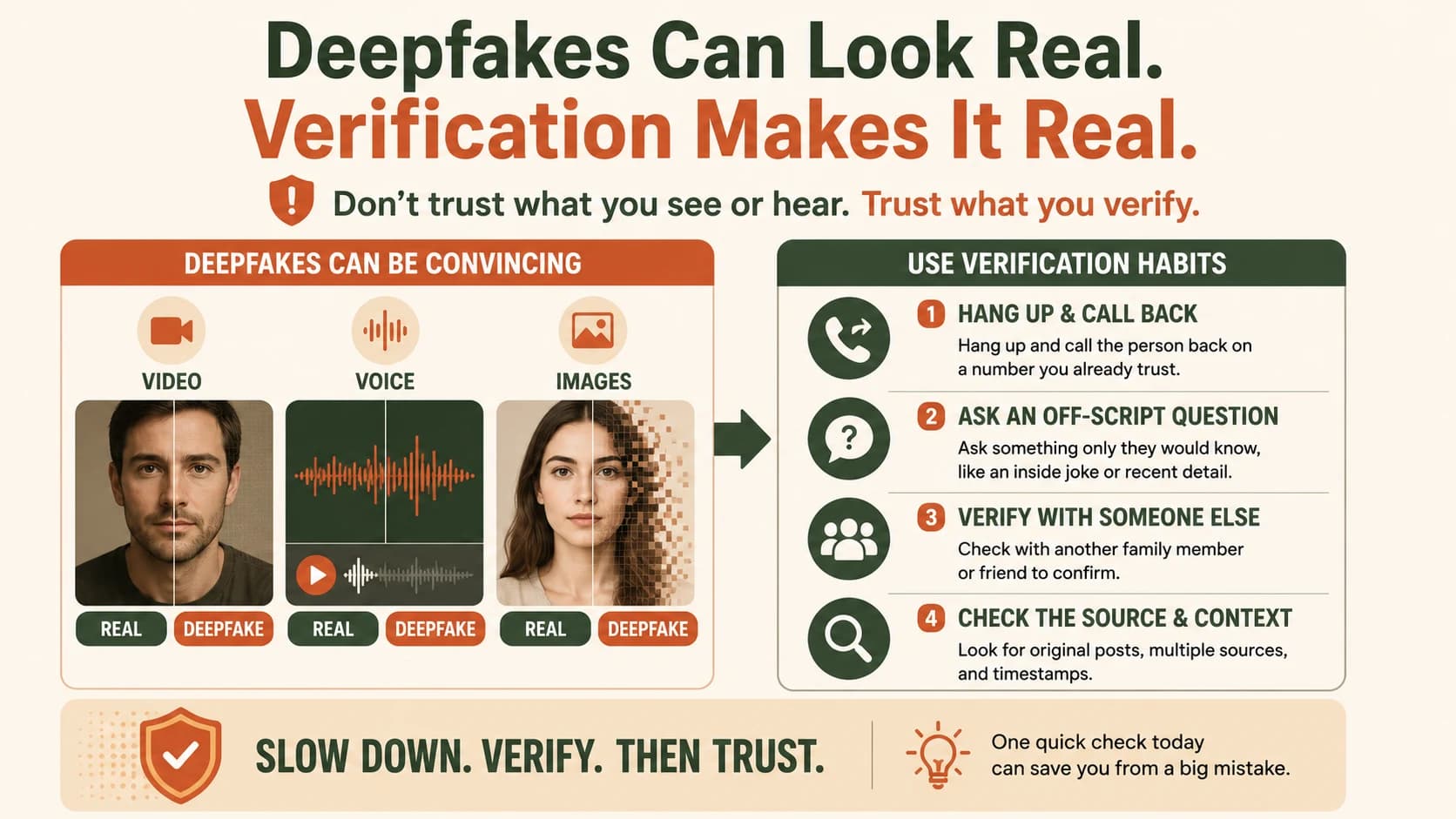
This is the part that actually works, and it's simpler than any visual checklist. When something urgent shows up by phone or video call, verify through a second channel before acting on it. Hang up and call the person back on a number you already had saved, not one they just gave you. Message a mutual contact. Log into the company's official site directly instead of clicking a link in the "urgent" message.
Agree on a family safe word or phrase in advance, something you'd only share in person, and ask for it if you ever get a distressed call claiming to be a loved one. A live deepfake can mimic a voice's tone, but it can't guess a password it was never trained on.
The off-script question does the same job without any advance planning. In one widely reported case, an attempted voice-clone scam targeting a company executive collapsed the moment someone on the call asked the "CEO" a personal question that only the real person could answer. It was something about a recent internal meeting, an inside detail no script would include. The clone had no answer, and the attempt fell apart in seconds.
This works because deepfake generation, however good it's gotten at mimicking appearance and voice, still can't improvise true information it was never given. A scripted fake breaks the moment you step off the script.
I find this the most reassuring fact in the whole topic: for all the progress in rendering faces and cloning voices, nobody has cracked improvisation. That's a narrower gap to defend than "spot every visual glitch," and it's one regular people can actually hold onto.
Tools That Can Help (Without Overselling Them)
Software can add a layer of defense, but treat every detection tool as a signal, not a verdict. Google's Chrome browser and Search now flag some AI-generated and AI-edited images directly, and detection tools built specifically for calls and meetings (used by security teams on platforms like Zoom and Teams) can catch some real-time voice and video fakes.
The honest limitation: Intel's FakeCatcher, one of the more studied detection systems, scores 96% accuracy in controlled lab tests but drops to about 91% on "wild" deepfakes collected from real online sources. Other detection tools have shown steeper real-world drops still.
Even a well-built detector, in other words, is a strong signal rather than a guarantee. Content-credential standards like C2PA, which attach a verifiable history to a piece of media, are a promising longer-term fix, but adoption across platforms is still uneven.
How to Spot a Deepfake Fast, Before You Trust It or Share It
Keep this short list in mind the next time something urgent, shocking, or too on-brand arrives by video, voice, or message.
- Pause before reacting, especially if the content is designed to make you feel panic, outrage, or urgency.
- Verify through a second channel: call back on a known number, or check a trusted, independently reached source.
- Ask an off-script question if you're on a live call and something feels off.
- Check for visual or audio tells (profile distortion, missing breath sounds, mismatched shadows), but treat a clean pass as a clue, not proof.
- Consider the source and context: who posted it, and is it coming from a reputable outlet or an anonymous account with no track record.
- Don't forward or act on unverified urgent media, even to "warn" others, since that's often exactly how it spreads.
Deepfakes aren't going away, and by next year the visual tells in this guide will likely have faded further as generators keep improving. What won't change is the underlying habit: unexpected, urgent media gets verified before it gets trusted or shared. That single behavior, more than any checklist of artifacts, is the real answer to how to spot a deepfake in 2026 and whatever comes after it.
If you want the basics on how the underlying generative AI actually produces this kind of synthetic media, that's a good next stop, and the ethics and safety library has more on where AI risk sits today.
FAQ