12 AI Careers You Can Start Without Writing Code (2026 Guide)
A practical, no-hype guide to 12 real AI careers that don't require coding, what they actually pay, what you need to start, and how to spot a scam.

In January 2026, LinkedIn's own labor data turned up something odd: postings that mention prompt engineering as a skill were up roughly 250%, while postings with "Prompt Engineer" as a job title had nearly disappeared. The job didn't vanish. It split into a dozen roles instead, most of which don't touch a line of code. I went looking for those twelve roles by reading the actual postings, not just the trend pieces about them, and the honest answer surprised me: the fastest way in almost never means starting over.
You can build a real AI career in 2026 without learning to code. The right lane depends on one question: what do you already do well? The strongest non-technical paths are AI training and evaluation, AI governance and compliance, and embedding AI into a role you already hold, marketing, HR, operations, support, or finance. This isn't a ranked list of "best AI jobs." It's a decision framework: answer a few questions about your background and your timeline, and you'll know which of the twelve lanes below is actually worth your next few weeks.
Key Takeaways
- You don't need to code to build a legitimate AI career in 2026, the fastest-growing non-technical lanes are AI training/evaluation, AI governance, and embedding AI into work you already do.
- The quickest entry point is gig-based AI training and evaluation work, often paid within 1-4 weeks of applying, but treat it as a bridge, not a destination. Pay is hourly and inconsistent.
- The highest long-term ceiling right now is AI governance: LinkedIn tracks demand for the skill up roughly 150% year-over-year, and US salaries for experienced analysts commonly land in the $85K-$160K range.
- Your existing expertise is usually worth more than a new AI certificate. Most credible non-technical AI roles are built on top of a job you can already do.
- A meaningful share of "no experience, high pay, AI job" postings online are scams. Check the red-flags section before you apply anywhere.
A note before you read further: the salary figures throughout are US-market approximations pulled from aggregated job-board and industry-survey data. They move fast and vary a lot by region, so treat them as a rough compass, not a quote.
Start From What You Already Know
Most "non-technical AI career" guides hand you a list of exotic job titles and let you guess which one fits. Skip that step. The fastest route into AI work isn't picking a trendy title, it's finding the AI-shaped version of something you already do well.
Table: Match your background to an AI career lane
| If your background is in... | Look at these lanes first |
|---|---|
| Teaching, tutoring, or deep subject expertise | AI Trainer / Model Evaluator, AI Content Reviewer |
| Marketing, content, or copywriting | AI-Enabled Marketing Strategist |
| HR, recruiting, or people operations | AI-Enabled HR Specialist |
| Customer support or CX | AI-Enabled CX Lead |
| Finance, accounting, or admin/ops | AI-Enabled Finance & Ops Analyst, AI Adoption Coordinator |
| Sales or account management | AI-Enabled Sales / RevOps Specialist |
| Legal, compliance, risk, or public policy | AI Governance & Compliance Analyst |
| Project or program management | AI Adoption Coordinator, AI Product Manager |
| Business analysis or strategy consulting | AI Agent Orchestrator, AI Product Manager |
| Generalist, student, or early career | AI Trainer, AI Content Reviewer, AI-Powered Virtual Assistant |
If you land in more than one row, that's normal, start with the lane closest to the top of your current job description, not the one that sounds most impressive on LinkedIn.
The 12 Career Lanes
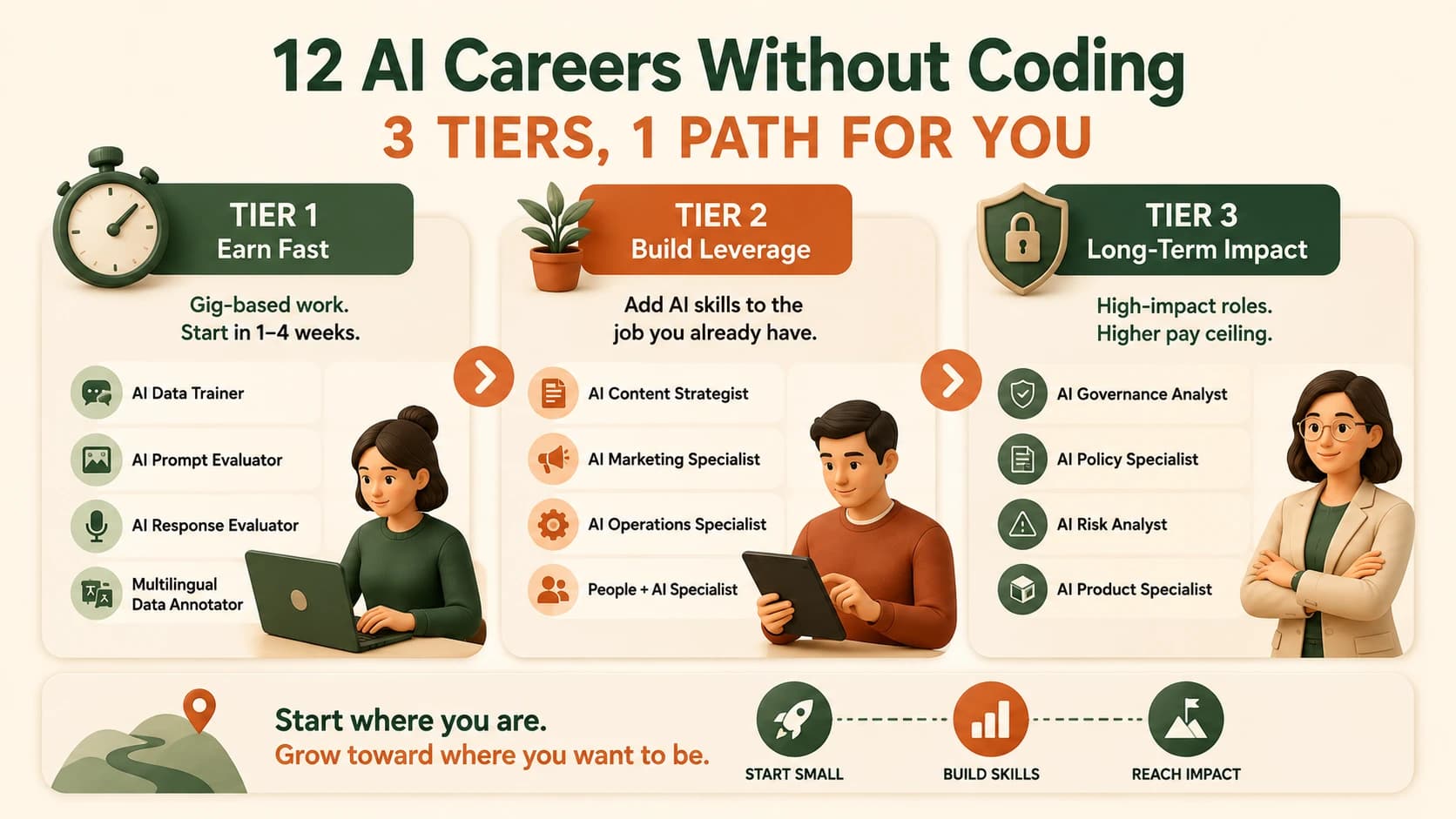
Tier 1: Start This Week
These are the fastest doors in. They're mostly contract or gig-based, the pay is decent but not life-changing, and you can realistically start earning within a few weeks. Think of this tier as proof-of-work and income while you build toward Tier 2 or 3, not a 20-year career plan.
1. AI Trainer / Model Evaluator
What it is: You review, rate, and correct AI-generated responses, checking facts, flagging unsafe or low-quality outputs, and giving structured feedback that helps a model improve. Companies need people with real subject knowledge (nursing, law, teaching, finance, coding, cooking, almost anything) to catch errors a generalist would miss.
Realistic pay: In the US, AI trainer roles average roughly $31/hour (ZipRecruiter puts the national average at $31.24/hour, ranging $13-$64/hour by location and platform). UK rates run closer to £15-£30/hour.
What you need: Strong writing, sharp judgment, and deep knowledge in one specific field. No degree or coding required.
Where to look: Platforms like Outlier, Mercor, and Mindrift connect subject-matter experts with AI companies' training pipelines. TrainAI's own guide confirms the bar is subject expertise and English fluency, not a coding or AI background.
Timeline: Most people pass an assessment and get their first paid task within 1-2 weeks. Research.com's career-path breakdown also tracks common progressions from here into annotation team lead, data quality manager, or AI policy analyst roles, useful context if this is meant as a bridge, not an end point.
Start this week: Pick the platform that best matches your strongest domain, take their qualification assessment, and be specific about your expertise on it, "eight years as a labor and delivery nurse" beats "healthcare background" every time.
2. AI Content & Prompt Quality Reviewer
What it is: Similar territory to AI training, but focused specifically on reviewing AI-generated marketing copy, chatbot scripts, or support responses for brands and agencies, checking tone, accuracy, and brand fit before it ships to customers.
Realistic pay: $18-$35/hour for freelance/contract work; higher if you specialize in a regulated industry (finance, healthcare, legal).
What you need: An editor's eye, familiarity with brand voice guidelines, and comfort giving structured written feedback.
Where to look: Marketing and content agencies increasingly hire this as a contract role; also available through the same evaluation platforms as Tier 1's AI trainer roles.
Timeline: 2-4 weeks to land a first contract if you already have an editing or content background.
Start this week: Build one sample "before/after" review of AI-generated copy (find any brand's chatbot or AI blog post, critique it) and use it as a portfolio piece when you pitch agencies.
3. AI-Powered Virtual Assistant
What it is: Freelance operational support, research, scheduling, inbox management, drafting, where your edge is knowing how to use AI tools (Claude, ChatGPT, Notion AI) to do the work faster and better than a traditional VA.
Realistic pay: Highly variable by market: roughly $15-$35/hour on global freelance platforms, higher for specialized niches (executive support, technical documentation).
What you need: Strong organizational skills plus fluency with a few AI tools, you're selling speed and quality, not novelty.
Where to look: Upwork, Fiverr, and direct outreach to small businesses and solo founders who can't yet afford a full-time hire.
Timeline: First client within 2-6 weeks, depending on how aggressively you pitch.
Start this week: Pick three AI tools you'll build your offer around, then create one concrete before/after example (e.g., "turned a messy meeting transcript into a clean action-item list in 4 minutes") to show prospective clients.
Tier 2: Built On What You Already Do
This is where most people should actually land, not switching careers, but becoming the person in your current function who knows how to use AI well. It pays better than Tier 1, it's more stable, and it doesn't require starting over.
4. AI-Enabled Marketing Strategist
What it is: A marketer who uses AI for research, drafting, personalization at scale, and campaign analysis, while owning the strategy, brand judgment, and final call that AI can't make on its own.
Realistic pay: Roughly $55K-$95K for mid-level roles in the US, with senior strategists exceeding that; freelance rates commonly $35-$75/hour.
What you need: Existing marketing fundamentals plus fluency in AI-assisted content, ad, and analytics workflows.
Start this week: Pick one recurring task in your current marketing job (briefs, ad copy variants, campaign reporting) and rebuild the workflow around an AI tool, then quantify the time saved. That number becomes your pitch for a raise, a promotion, or a new role.
5. AI-Enabled HR Specialist
What it is: HR and people-ops work, screening, job description drafting, engagement survey analysis, onboarding, where AI tools handle the repetitive layer so you can focus on culture, retention, and hard conversations.
Realistic pay: Roughly $50K-$90K for mid-level HR roles with an AI-fluency premium; senior people-ops leads can exceed this.
What you need: HR fundamentals plus comfort using AI for screening and drafting without letting it make judgment calls on people.
Start this week: Audit your current hiring pipeline for the one step that eats the most hours (usually resume screening or first-draft job descriptions) and pilot an AI-assisted version of it.
6. AI-Enabled Customer Experience (CX) Lead
What it is: Owning support quality in a world where AI agents handle a growing share of tickets, designing escalation rules, auditing AI-handled conversations, and protecting the human touch where it actually matters.
Realistic pay: Roughly $55K-$95K for CX leads with AI-oversight responsibilities in the US market.
What you need: Support or CX experience, plus the judgment to know when a conversation needs a human, not a bot.
Start this week: If your company already uses an AI support tool, volunteer to audit a week of its transcripts and report on where it's failing customers, that audit is exactly the skill this role is built on.
7. AI-Enabled Finance & Operations Analyst
What it is: Reconciliations, variance analysis, and reporting, increasingly assisted by AI, freeing you to focus on the analysis and recommendations that actually require judgment.
Realistic pay: Roughly $60K-$100K for mid-level finance/ops analysts with AI-tool fluency in the US.
What you need: Existing finance or operations fundamentals (spreadsheets, reconciliation logic) plus willingness to pilot AI tools on repetitive reporting tasks.
Start this week: Take your most repetitive monthly report and time how long it takes by hand, then time an AI-assisted first draft of the same report. That comparison is your business case.
8. AI-Enabled Sales / RevOps Specialist
What it is: Using AI for lead research, call summarization, CRM hygiene, and follow-up drafting, while you keep the actual relationship and negotiation, which is still a human skill.
Realistic pay: Roughly $55K-$100K+ base for AI-fluent sales/RevOps roles in the US, often plus commission.
What you need: Sales or RevOps fundamentals plus comfort using AI to remove the busywork between conversations.
Start this week: Use an AI tool to draft your next five follow-up emails from call notes, and track whether response rates improve. Bring that data to your next 1:1.
Tier 3: New Specialist Titles
These are dedicated, still-forming job titles, not embedded add-ons to an existing role. They generally require more ramp-up than Tiers 1-2, but the ceiling is meaningfully higher, and demand is growing fast because regulation and enterprise AI adoption are both accelerating at once.
9. AI Governance & Compliance Analyst
What it is: Making sure an organization's AI use is documented, risk-assessed, and compliant with frameworks like the NIST AI Risk Management Framework and regulations like the EU AI Act, a role that barely existed three years ago and is now one of the fastest-growing specialisms in the market.
Realistic pay: IAPP's 2025-26 Salary and Jobs Report puts the median for AI-governance-focused professionals at $151,800, with those handling both privacy and AI governance median at over $169,700. TechJack Solutions' breakdown of 20 AI governance roles puts entry-level analyst pay at $75K-$130K, scaling to $190K-$250K+ at the director tier.
What you need: A background in compliance, legal, risk, audit, privacy, or public policy transfers directly. Entry-level titles like AI Policy Analyst or AI Governance Administrator are explicitly open to career-changers from these fields.
Where to look: Specialist boards for governance/risk/compliance roles, plus general job boards searching "AI governance," "AI compliance," or "responsible AI."
Start this week: Read a plain-language summary of the EU AI Act's risk tiers and the NIST AI RMF's four functions (Govern, Map, Measure, Manage), being able to speak that vocabulary fluently in an interview puts you ahead of most applicants.
10. AI Adoption / Implementation Coordinator
What it is: The project manager for a company's AI rollout, running pilots, training staff, tracking what's actually working versus what's just a demo, and being the translator between the tools and the people who have to use them.
Realistic pay: Roughly $60K-$100K for mid-level coordinators in the US, scaling with company size and scope of the rollout.
What you need: Project or program management experience. You don't need to build the AI systems, you need to make sure the humans around them actually adopt them well.
Start this week: Volunteer to lead (or shadow) whatever AI pilot is already happening inside your current company, even informally. Real rollout experience, documented, is the strongest resume line for this role.
11. AI Agent Orchestrator (Business Track)
What it is: As companies deploy fleets of AI agents instead of single chatbots, someone has to decide which agent handles what, set the checkpoints where a human reviews the work, and catch it when an agent quietly gets something wrong. The technical version of this role sits inside engineering; the business-track version, which doesn't require building the agents, focuses on workflow design, quality verification, and knowing when to pull a human back into the loop.
Realistic pay: Still an emerging, inconsistently titled role; compensation data is thin, but postings that combine "AI" with senior business-analyst or product responsibilities commonly land in the $90K-$150K range in the US.
What you need: Strong process design skills (mapping a multi-step workflow, defining handoffs, setting quality gates) and enough AI fluency to know what a model can and can't be trusted to do unsupervised.
Start this week: If you want a genuinely hands-on feel for what this role oversees, our Inside the Agent path walks through how multi-agent systems are actually built, you don't need to write the code to benefit from understanding the shape of the thing you'd be managing.
12. AI Product Manager (Non-Technical Track)
What it is: Owning the roadmap for an AI-powered feature or product, translating what customers need into requirements, deciding what the AI should and shouldn't do, and working with engineers without needing to write the model code yourself.
Realistic pay: Roughly $90K-$150K in the US for PM roles with AI product responsibilities, tracking general product management bands with an AI premium.
What you need: Product sense, the ability to write clear specs, and enough technical literacy to have an informed conversation with an engineering team, not the ability to build what they build.
Start this week: Write a one-page product spec for an AI feature you wish existed in a tool you already use daily. It's the single most common exercise in AI PM interviews.
Red Flags: How to Spot a Fake "No-Experience AI Job"
The demand described above is real, which is exactly why it attracts scams. Watch for:
- Upfront fees. Any listing that asks you to pay for "certification," a "starter kit," or to "unlock" tasks before you can work.
- Guaranteed high pay with zero screening. Legitimate AI training and evaluation platforms all use a qualification assessment. If there isn't one, be suspicious.
- Payment only in gift cards or crypto. Not how real contract work pays.
- Recruitment pressure. If the "job" is mostly about getting you to recruit others, it's not a job.
- No identifiable company. Vague branding like "AI Project" or "Global AI Team" with no findable company page or LinkedIn presence.
- Unrealistic promises. "$10,000/month, 2 hours a day, no experience" is not how any role in this article actually works.
Which Lane Should You Actually Pick?
Four questions decide this, not a ranked list of "best AI jobs." Answer them honestly and the right tier falls out on its own.
1. Do you need income in the next few weeks, or can you play a longer game? If you need money now, that alone answers it: start in Tier 1. It's real, it's fast, and it's honest work, even if it's not glamorous.
2. Do you already hold a stable job in marketing, HR, support, finance, sales, or ops? If yes, Tier 2 beats Tier 1 almost every time. You keep your income while building the AI-fluency layer on top of a function you already know, which compounds faster than starting over in a gig lane.
3. Do you have real domain depth in law, compliance, risk, or project management? If yes, skip straight to Tier 3. Your existing credibility transfers directly, and you'll be competing against far fewer qualified applicants than a generalist would.
4. Are you starting from zero, no domain, no existing job to build on? Start in Tier 1 anyway, but treat it explicitly as a bridge. Use the first few months to find which Tier 2 or Tier 3 lane your growing AI fluency actually points toward, then move.
The honest exception: if none of this urgency applies, you're not currently job-hunting, you're just curious, you don't need any of these tiers yet. Read the Red Flags section below, bookmark this page, and come back when you're actually applying. Tier 3 in particular rewards patience more than speed.
If you're starting from zero on the AI side of this, our Getting Started path covers the literacy layer, what these tools actually are and how they work, with no coding required for the first several modules.
Frequently Asked Questions
FAQ