How to think about AI: a beginner's mindset guide
AI isn't magic or just autocomplete. Learn how to think about AI correctly, avoid hallucinations, and get real results with a simple collaboration model.
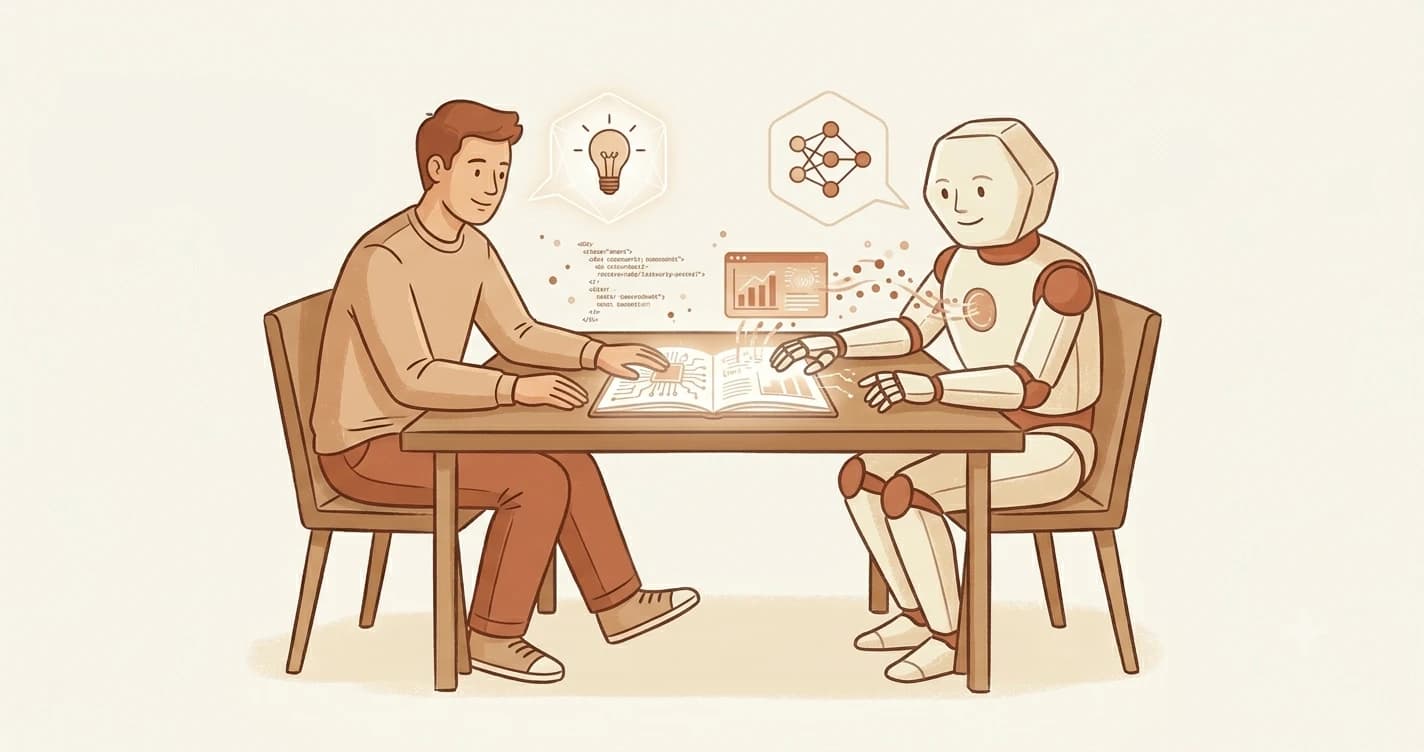
The most common AI mistakes aren't technical. They happen before anyone touches a keyboard.
People either trust AI too much, treating it like an oracle that can't be wrong, or they dismiss it too quickly, deciding it's nothing more than fancy autocomplete. Both attitudes produce bad results. How to think about AI correctly is the most important skill in this whole course, and this lesson gives you the calibration you actually need.
Key Takeaways
- AI doesn't know what it doesn't know, it can sound confident while being completely wrong
- Hallucinations are a normal part of how language models work, not a glitch to be fixed
- AI is a genuine multiplier for human work: it drafts, summarizes, explains, and plans at speed
- The collaboration loop is: You direct → AI drafts → You review → You decide
- The quality of your prompts determines the quality of the output, context is the variable you control
Why does AI sound so confident even when it's wrong?
Here's something that surprises most beginners: AI models have no idea when they're wrong.
When you ask a language model a question, it predicts the most statistically likely next token, over and over, until it stops. It doesn't consult a database. It doesn't check its answer. It generates a response that fits the pattern of useful responses it learned from training.
This means it can produce a fluent, confident, well-structured answer that is completely fabricated; and it has no way to flag the difference.
This is called hallucination: the model generates plausible-sounding content that is inaccurate or made up. In 2025, Deloitte delivered an AI-generated report to the Australian government containing fabricated citations, non-existent experts, and fake research papers. The government demanded a $60,000 refund. The AI had invented the sources — with complete confidence.
That's an extreme case, but the underlying pattern is common. AI hallucinates specific facts, statistics, quotes, names, dates, and citations, the exact things that are hardest to catch if you don't know the subject.
Never copy an AI-generated fact into anything important, a work document, a public post, a client email, without checking it. Confident delivery is not a signal of accuracy.
The fix is simple: treat AI output like a first draft from a smart, fast, occasionally unreliable collaborator. Directionally useful. Never final without a read-through.
Is AI really just autocomplete?
The opposite mistake is just as limiting. Once people understand tokens and prediction, some conclude AI is "just autocomplete", a glorified spellchecker that can't do anything genuinely useful.
That undersells it significantly.
Here's what AI does well, right now, at no cost, for anyone who takes five minutes to learn the basics:
- Drafts a solid first version of almost any written document in seconds
- Summarizes a long article, report, or meeting transcript into bullet points
- Explains a confusing concept five different ways until one clicks
- Reviews code or writing and flags issues you missed
- Turns a messy list of ideas into a structured outline
- Answers follow-up questions without making you start over
None of that requires the model to "think" in any philosophical sense. It just requires the ability to predict useful text at speed, and these models are extraordinarily good at that.
A useful frame: AI is a very fast, very well-read first draft machine. It doesn't need inspiration or coffee breaks. It doesn't get blocked. It gives you something to react to, which is almost always easier than starting from nothing.
Research from Atlassian found that people who treat AI as a strategic collaborator (rather than a task-completion tool) save over 100 minutes per day. That gap comes entirely from mindset, not from using different software.
How to think about AI: the collaboration loop that works
Here's the mental model worth keeping. Four steps:
- You direct, describe what you want, with enough context to be useful
- AI drafts, it produces the first version fast
- You review, read critically, catch errors, identify what's missing
- You decide, you refine it and put your judgment behind the result
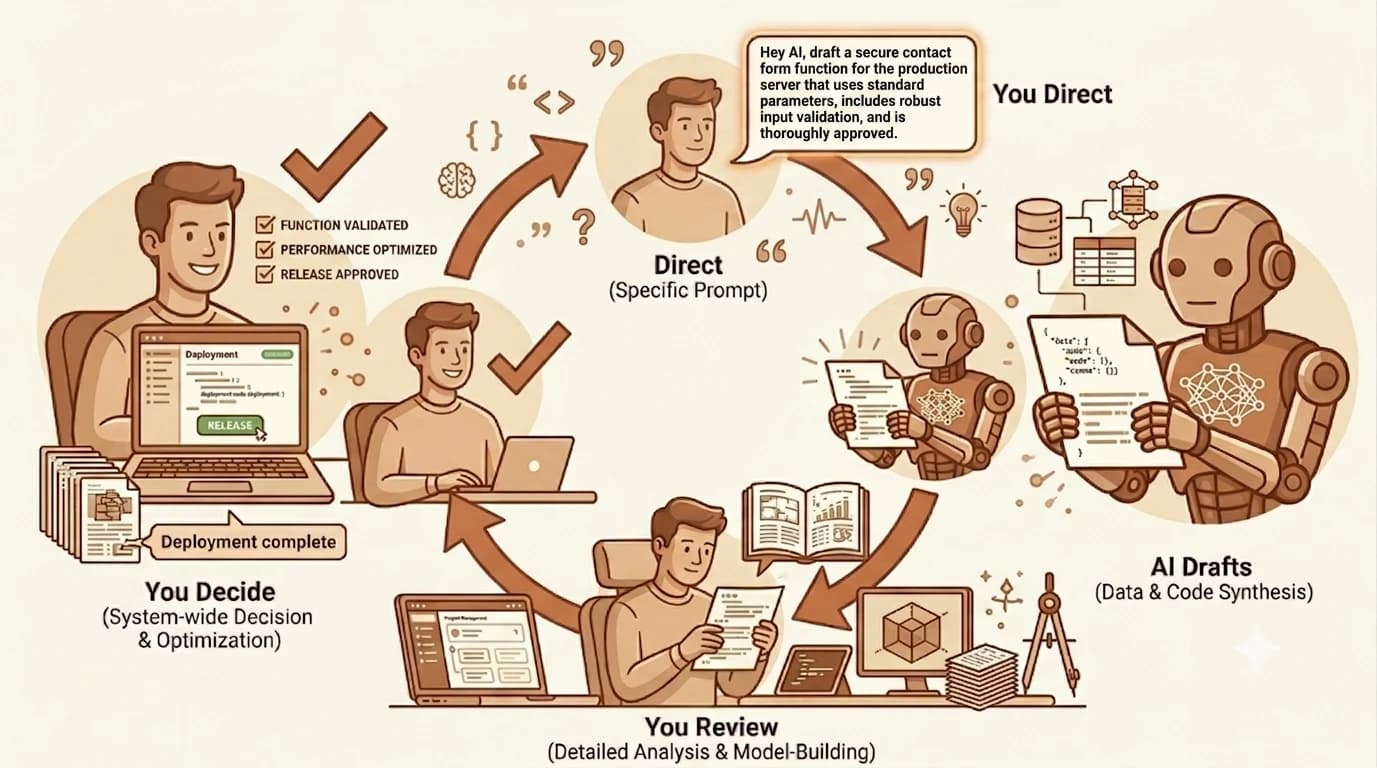
Notice who makes every important decision. You do. AI handles the time-consuming middle parts.
The quality of this loop depends almost entirely on Step 1. Think of prompting like briefing a capable new hire who knows nothing about your situation. They're smart and fast, but they can only work with what you give them. Tell them the audience, the goal, the tone, the constraints, and the output gets dramatically better. Leave all of that out, and you'll get a generic response that misses the point.
The more context you give, the more useful the output. "Write me an email" will produce something generic. "Write a two-paragraph follow-up to a potential client who attended our webinar on Tuesday, professional but warm, include our pricing page link, end with a clear next step" will produce something you can actually send.
This is why people who try AI once, get a mediocre response, and decide it's overhyped are usually giving it a mediocre prompt. The tool didn't fail. The briefing was incomplete.
What you've built in Module 01
You now have a complete mental map of the AI landscape.
You understand what AI actually is, pattern recognition, not intelligence, not magic. You know how language models work under the hood: tokens, training, prediction. You've seen the difference between a chatbot that responds and an AI agent that acts on its own. And now you know how to think about AI as a collaborator — not a magic box, not a toy — in a way that will serve you through everything that follows.
The Getting Started path closes here. But this is also where things get genuinely interesting.
The next curriculum, Master Agentic AI, picks up exactly where you left off. You'll go from understanding AI to building with it: agents that use tools, systems that take actions, and workflows you design and deploy yourself. Everything in Module 01 was preparation for that.
You're ready.
Quick Check
You ask an AI for the publication date of a research paper. It gives you a confident, specific answer. What should you do?
You try AI once, give it a vague prompt, and get a generic useless response. What is the most likely cause?
Which of these is the best description of the collaboration loop?
Your Task
Run the collaboration loop on a real task
Pick something you actually need this week, an email, a summary, an outline. Write a prompt that gives AI the context a new hire would need: audience, tone, goal, constraints. Get a draft back, then review it critically and note one thing you'd change before using it.
This takes under 5 minutes and turns the four-step loop (You direct → AI drafts → You review → You decide) from a concept into a habit.
Done? You've completed Lesson 01.08, and all of Module 01.
FAQ