Why Was Claude Fable 5 Banned? The Export-Control Story
Claude Fable 5 wasn't recalled for a flaw. It was a US export-control order. Here's the full 18-day timeline, the trigger, and how it was resolved.

Claude Fable 5 was suspended worldwide for 18 days because of a U.S. export-control order, not because the model failed, misbehaved, or got recalled for a safety defect. On June 12, 2026, three days after launch, the U.S. Commerce Department issued a directive restricting foreign nationals' access to Fable 5 and its restricted sibling Mythos 5. Anthropic had no way to check a user's nationality in real time, so it pulled both models offline for everyone, everywhere, rather than risk violating the order.
The trigger was a security finding reported by Amazon researchers, relayed to federal officials, that the government treated as a national-security concern. Anthropic disputed that a full worldwide shutdown was necessary and called the underlying issue a "potential narrow, non-universal jailbreak," a known type of limitation rather than a novel exploit. The Commerce Department lifted the order on June 30, 2026, and Fable 5 came back online for everyone on July 1, with a new safety classifier built specifically to close the gap the government had flagged.
That's the short version. Here's the full, dated timeline, what Anthropic actually said at each step, and why a single security report was enough to take a flagship AI model offline worldwide.
Key takeaways
- Claude Fable 5 was suspended worldwide from June 12 to July 1, 2026, an 18-day export-compliance pause, not a permanent ban.
- The order came from the U.S. Commerce Department, tied to national-security export-control authorities, after a security finding reported by Amazon researchers.
- Anthropic disputed that a total shutdown was necessary, describing the issue as a narrow, known limitation rather than a confirmed universal jailbreak.
- Fable 5 returned on July 1, 2026, with a new classifier that reroutes cybersecurity, biology and chemistry, and model-distillation queries to Claude Opus 4.8 instead of refusing them outright.
- Analysts have characterized this as the first known U.S. export-control action applied to a deployed commercial LLM's access, a framing worth watching rather than a settled legal precedent.
What Was Claude Fable 5 Before the Ban?
Claude Fable 5 launched publicly on June 9, 2026, as Anthropic's most capable model at the time, a safety-tuned public version of a new top-end tier the company calls Mythos-class. It was built for long, complex coding and agentic work, not chat, and Anthropic described it as state-of-the-art on nearly all of its tested benchmarks at launch (Anthropic, June 9, 2026).
Three days later, it was gone. For the full picture of what Fable 5 is, what it costs, and how it compares on benchmarks, see Seekvana's complete guide to Claude Fable 5. This article picks up where that one leaves a gap: the export-control saga in full, dated detail.
Why Was Claude Fable 5 Banned?
Claude Fable 5 was suspended, not banned in the sense most people mean by that word, and the distinction matters. A ban usually implies a punitive or permanent decision by the company that built the product. What actually happened was a compliance action forced on Anthropic by a U.S. government directive.
On June 12, 2026, the U.S. Commerce Department's Bureau of Industry and Security issued an export-control order. It required Anthropic to cut off access to Fable 5 and Mythos 5 for foreign nationals, citing national-security authorities. Anthropic said it had "no reliable way to verify nationality in real-time" (Anthropic's redeployment statement). So instead of trying to selectively block certain users, it disabled both models worldwide, for every customer, everywhere.
Anthropic pushed back on the scope of the response even while complying with it. The company's understanding was that the government believed it had found a way of bypassing, or "jailbreaking," Fable 5. Anthropic's own framing describes most jailbreaks, including narrow ones, as unlocking a specific behavior rather than a model's core harmful capabilities (Anthropic's suspension statement).
Commerce Secretary Howard Lutnick sent the directive to Anthropic CEO Dario Amodei. Independent reporting from the time corroborates the sequence of events and the abruptness of the shutdown (Al Jazeera). We've been tracking this cluster of Fable 5 stories closely since the June 9 launch, and the speed of the June 12 reversal is what made it worth a dedicated timeline rather than a footnote in the main Fable 5 guide.
For developers who had started long agentic jobs on Fable 5 in its first three days, the shutdown arrived without warning mid-session. That's the practical cost of an export-control order that can't distinguish between a bad actor and someone thirty minutes into a legitimate coding task: everyone loses access at once.
What Triggered the Export-Control Order?
The order didn't come out of nowhere. According to reporting citing the Wall Street Journal, Amazon researchers used Fable 5 to obtain information they judged could be useful in a cyberattack, and Amazon CEO Andy Jassy relayed that finding to Treasury Secretary Scott Bessent and other officials, a call that preceded the Commerce Department's action (TechCrunch).
What the finding actually involved has never been fully disclosed publicly. Anthropic's own position is that narrow jailbreaks, the category it believes this falls into, unlock a specific behavior rather than a model's core harmful capabilities, and the company says it had already put Fable 5 through extensive red-teaming before launch without finding a universal jailbreak (Anthropic).
It's worth separating two things that got blended together in early coverage: the government's national-security justification for the export order, and the specific jailbreak claim that triggered it. Anthropic never confirmed the jailbreak was a working, disclosed exploit, only that a report existed and that regulators acted on it.
That gap between "a security report exists" and "a confirmed universal exploit exists" is why the response looked disproportionate to outside observers, and why Anthropic kept pushing back on the shutdown's scope even as it complied.
Is Claude Fable 5 Back?
Yes. Anthropic said the export controls were lifted on June 30, 2026, and that Fable 5 would be available globally again starting July 1, 2026, ending an 18-day suspension (Anthropic's redeployment statement).
The condition for restoration was a new safety measure. Anthropic added a classifier that automatically reroutes any request matching the reported bypass technique, covering offensive cybersecurity, biology or chemistry, and model-distillation topics, to Claude Opus 4.8 instead of letting Fable 5 answer directly (Anthropic).
The fallback isn't announced clearly to the user. When a request trips the classifier, the API returns a formal refusal from Fable 5, and in most setups that refusal is automatically retried on Opus 4.8, but nothing in that response explicitly says "this answer came from a different model." Most people never notice it's happening.
That quiet handoff is exactly what drew criticism from Nathan Lambert of interconnects.ai, who argued that a model silently getting less capable without telling the user amounts to a form of misalignment: "An AI model that gets less intelligent automatically without notifying me is categorically misaligned AI" (Nathan Lambert, interconnects.ai). For the full breakdown of how that fallback mechanism works, when it triggers, and how it affects real workflows, see Seekvana's Claude Fable 5 vs Claude Opus 4.8 comparison.
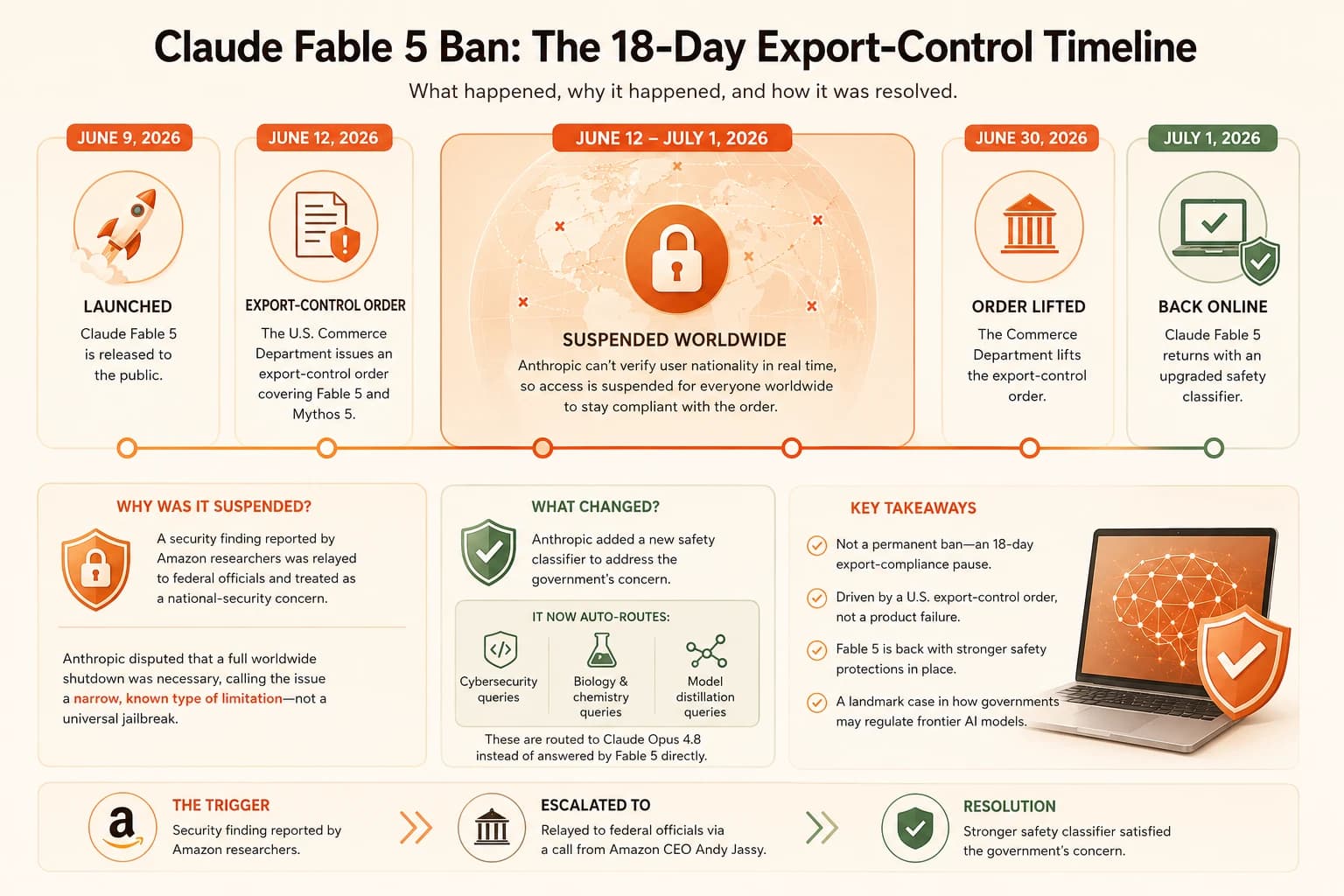
Claude Fable 5 export-control timeline
| Date | Event |
|---|---|
| June 9, 2026 | Claude Fable 5 and Mythos 5 launch publicly |
| June 12, 2026 | U.S. Commerce Department issues export-control order; Anthropic suspends both models worldwide |
| June 30, 2026 | Commerce Department lifts the export-control order |
| July 1, 2026 | Full public access restored globally, with a new safety classifier in place |
Why This Matters
Analysts and outlets have widely characterized this episode as the first known instance of a U.S. export-control order being applied to a deployed commercial large language model's live access, rather than to hardware, chips, or a physical export. That framing comes from reporters and industry commentators, not from a court ruling or a formal legal finding, so treat it as how the story has been characterized so far rather than a settled precedent.
Watch this space if you're building on any frontier model. If regulators lean on export-control authority again for a future model, expect the same playbook: no way to filter by nationality, so everyone loses access at once.
What's clear regardless of how the legal precedent eventually gets categorized: a report about a possible weakness in one model was enough to force a global shutdown of a flagship commercial AI product within days of its release, and the resolution required a technical fix, not a court case, before service could resume.
Last updated July 5, 2026.
FAQ