What Is Claude Fable 5? Pricing, Specs, and the Ban
Claude Fable 5 is Anthropic's most capable public model, launched June 2026. See pricing, specs, benchmarks, and why it was briefly banned.

Claude Fable 5 is Anthropic's most capable publicly released AI model, launched on June 9, 2026. It's the safety-tuned public version of a new top-end model tier called "Mythos-class," which Anthropic describes as sitting above its existing Opus line in raw capability. It costs $10 per million input tokens and $50 per million output tokens, runs on a 1-million-token context window, and is built for long, complex reasoning and coding work rather than short chat replies.
Despite the name, it's not a storytelling model. Fable 5 was briefly pulled offline worldwide between June 12 and July 1, 2026, after a U.S. export-control order, then restored with a stronger safety classifier. Here's what it actually is, what it costs, and what changed.
Key takeaways
- Claude Fable 5 launched June 9, 2026, as the safety-hardened public sibling to a more powerful, access-restricted model called Claude Mythos 5.
- Pricing is $10 per million input tokens and $50 per million output tokens, with a 90% discount available through prompt caching.
- It was suspended worldwide from June 12 to July 1, 2026, after a U.S. export-control order tied to a reported security finding, not because the model failed or misbehaved on its own.
- On Anthropic's own SWE-Bench Pro results, Fable 5 scores 80.3%, ahead of Opus 4.8 at 69.2%, GPT-5.5 at 58.6%, and Gemini 3.1 Pro at 54.2%.
- Fable 5 automatically reroutes certain flagged requests to Claude Opus 4.8 instead of answering directly, a mechanism Anthropic calls a safety classifier and most users never notice.
What Is Claude Fable 5?
Anthropic's own naming logic is worth clearing up first, because it's the single biggest source of confusion around this launch. Fable comes from the Latin fabula, "that which is told," the same root sense as the Greek word mythos. That's a naming choice about lineage, not a claim about what the model is good at. Fable 5 is a reasoning, coding, and agentic-work engine, not a fiction or storytelling tool, and Anthropic says so directly in its own launch materials (Anthropic, June 9, 2026).
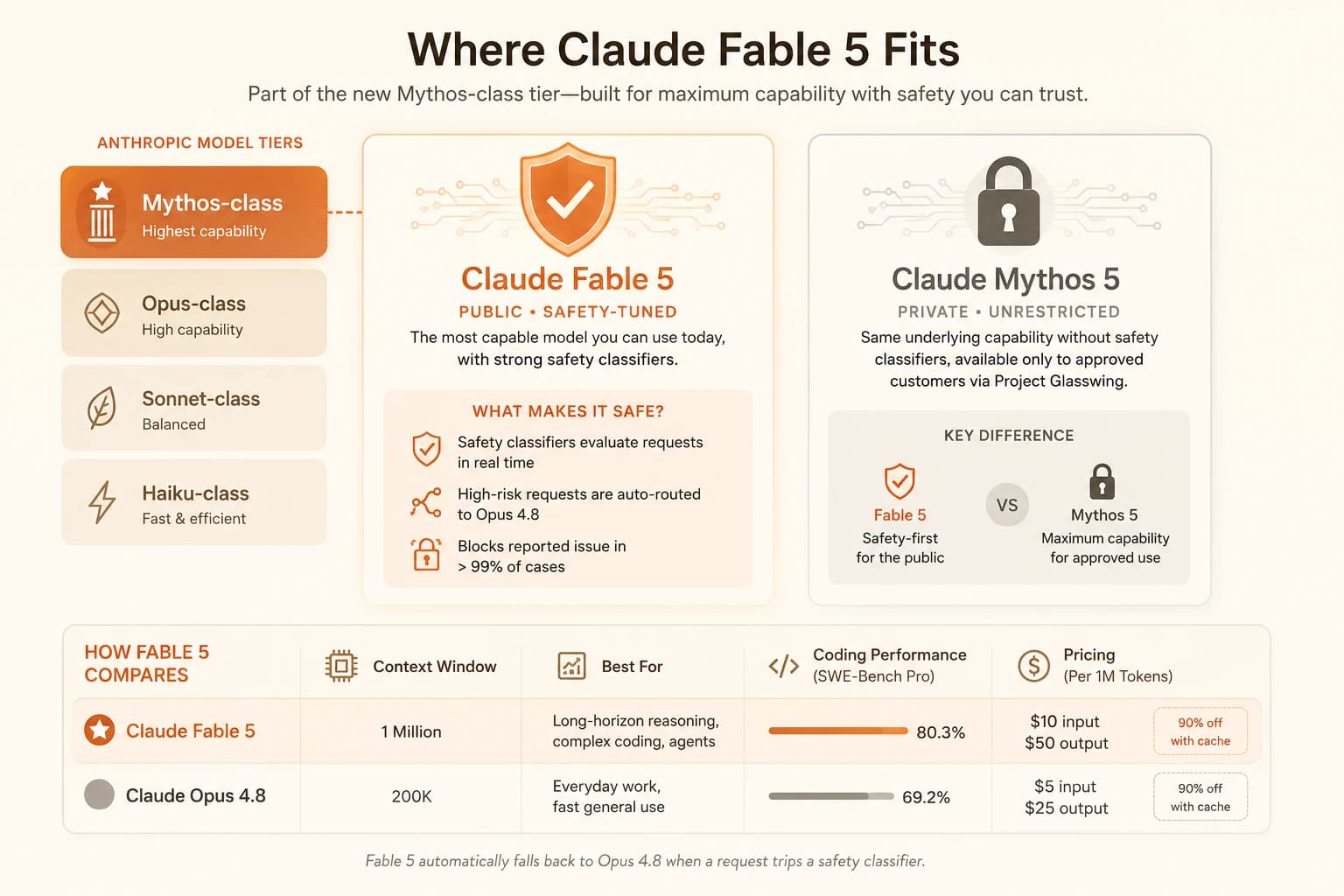
Fable 5 sits inside a new tier Anthropic calls Mythos-class, which the company describes as a tier of models above its existing Opus class in capability. Two models share that tier at launch:
- Claude Fable 5, the publicly available, safety-tuned version. This is the model you can actually sign up for.
- Claude Mythos 5, the same underlying capability, without the safety classifiers, offered only to approved customers through a program Anthropic calls Project Glasswing.
In practice, that means Fable 5 and Mythos 5 are the same model wearing different amounts of armor. Fable 5 is the one built for general use: it can decline a request outright when a safety classifier trips, something Opus, Sonnet, and Haiku models don't do in the same way. Mythos 5 skips that layer entirely, which is exactly why it stays behind an approval process instead of shipping to everyone.
Anthropic describes Fable 5 as state-of-the-art on nearly all of its tested benchmarks, spanning software engineering, general knowledge work, vision, and scientific research, not just one narrow skill (Anthropic, June 9, 2026). That breadth is the point of a Mythos-class model: it's built to hold a plan together across a long, messy task, not just answer one well-scoped question better than the last model did.
If you've used an AI agent before, that's the closest frame for what Fable 5 is designed to do well: not answer one question and stop, but plan across many steps, call tools, check its own work, and keep going for hours without a human in the loop. That matters if you've ever had a large language model lose the thread halfway through a multi-step task. Fable 5's 1-million-token context window and long-horizon design exist specifically to reduce how often that happens. For a hands-on look at what that autonomy actually looks like, see Seekvana's guide to how to use Claude Fable 5.
If you only remember one thing about the name: Fable tells stories the way a senior engineer "tells a story" in a design doc, not the way a novelist does. It's a coding and reasoning model first.
Specs, Pricing, and Availability
Here's what you actually get and what it costs, according to Anthropic's own documentation.
Claude Fable 5 specs and pricing at a glance
| Spec | Claude Fable 5 |
|---|---|
| Launch date | June 9, 2026 |
| Context window | 1,000,000 tokens |
| Max output per request | 128,000 tokens |
| Input price | $10 per million tokens |
| Output price | $50 per million tokens |
| Prompt-cache discount | Up to 90% |
| Data retention | 30 days (no zero-retention option) |
Both Fable 5 and Mythos 5 launched at this same price point, which Anthropic notes is substantially cheaper than the earlier, more limited "Mythos Preview" model that came before it (Claude Platform docs).
For comparison, Claude Opus 4.8 costs noticeably less: $5 per million input tokens and $25 per million output tokens at standard rates (Anthropic's Opus page). Fable 5 runs roughly twice the price of Opus 4.8, which matters when you're deciding which model to route a given task to. More on that below.
If you're weighing Fable 5 against other options in Seekvana's AI tools library, availability matters as much as price. Fable 5 is generally available on:
- Claude.ai (Pro, Max, Team, and seat-based Enterprise plans)
- The Claude API and consumption-based Enterprise plans
- Amazon Bedrock and Claude Platform on AWS
- Google Cloud (Vertex AI)
- Microsoft Foundry
Subscription-plan access rolled out in phases through June 22, 2026, after which continued Fable 5 usage on a subscription plan requires usage credits rather than being fully bundled into the flat monthly price.
Claude Mythos 5, the unrestricted sibling, is not generally available. It's limited to approved customers through Project Glasswing. Most people building with Claude will only ever touch Fable 5, and that's by design.
One detail worth flagging if you're building a product on top of it: Fable 5 and Mythos 5 both carry a fixed 30-day data-retention window, and neither is available under Anthropic's zero-data-retention option. If your team has compliance requirements around how long customer prompts and outputs are stored, that's a constraint to check before you commit to Fable 5 for a production workload, not something to discover after launch.
Why Was Claude Fable 5 Banned?
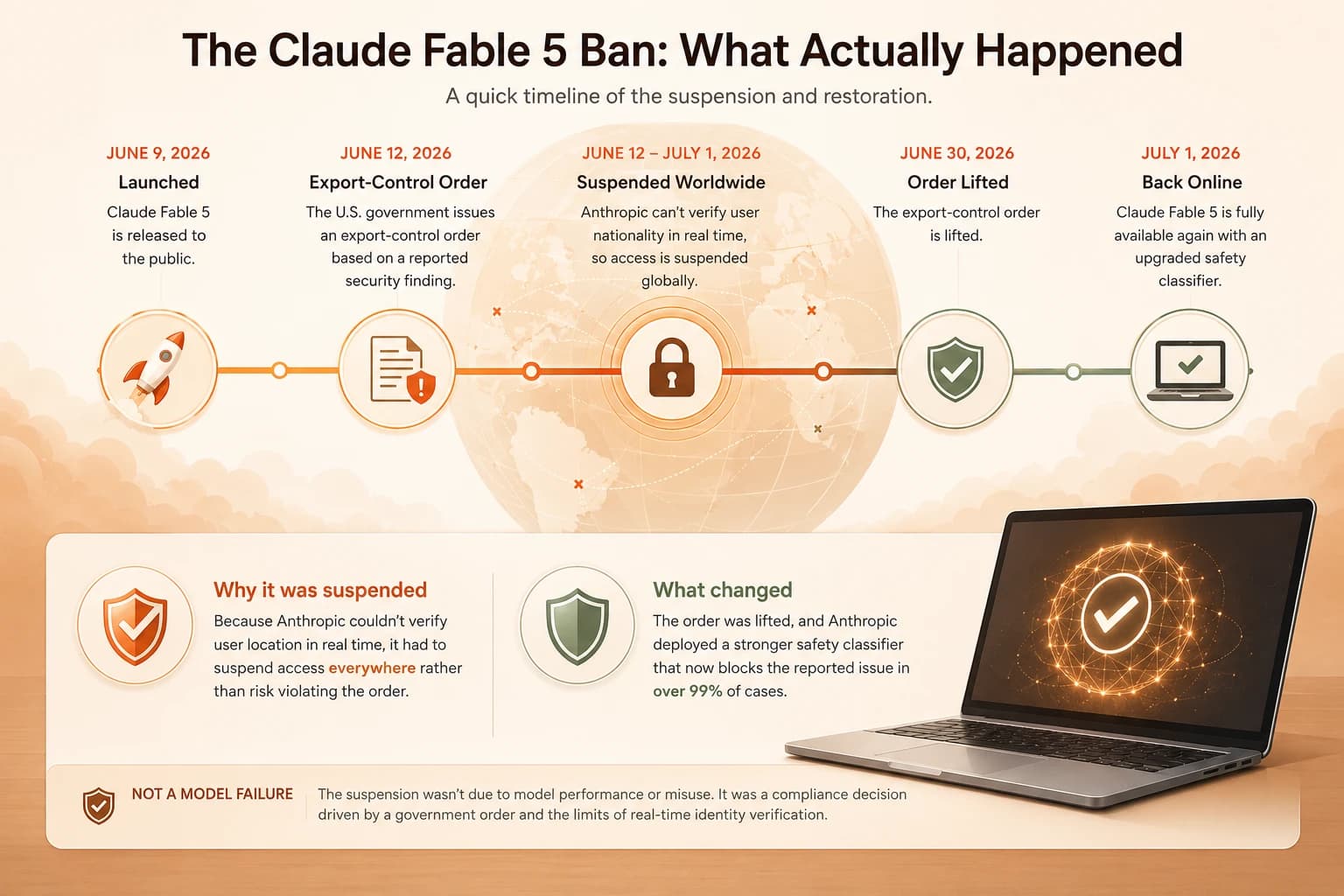
Claude Fable 5 wasn't banned for misbehaving. It was suspended worldwide for 18 days because of a U.S. government export-control order, and Anthropic restored it once that order was lifted. If you'd built a product on top of Fable 5 in its first three days, this is the outage that pulled the model out from under you with no warning, which is exactly why it's worth understanding the mechanism instead of just the headline.
Claude Fable 5 suspension timeline
| Date | Event |
|---|---|
| June 9, 2026 | Fable 5 and Mythos 5 launch publicly |
| June 12, 2026 | U.S. export-control order applied; Anthropic suspends both models worldwide |
| June 30, 2026 | Export controls lifted |
| July 1, 2026 | Full public access restored globally |
Anthropic's own account of what happened is worth reading in its own words: the government issued an export-control directive tied to national-security authorities, and Anthropic says it "had no reliable way to verify nationality in real-time," so it disabled both models for every user everywhere rather than try to selectively block only foreign nationals (Anthropic's redeployment statement). The order followed a security finding reported by Amazon researchers, and Anthropic has published more detail on the specific safeguard it built in response (Anthropic's jailbreak-framework post).
When Fable 5 came back on July 1, it shipped with a strengthened classifier that Anthropic says blocks the reported technique in over 99% of cases, automatically rerouting any blocked request to Claude Opus 4.8 instead of just refusing it outright.
Anthropic has since published a severity framework for rating jailbreak reports, developed with its Project Glasswing partners, so a single narrow finding is less likely to trigger a repeat of a worldwide shutdown (Anthropic's jailbreak-framework post). Whether that framework holds up the next time a similar report surfaces is still an open question worth watching.
This section covers the short version. The full timeline, including the export-control mechanics and what changed in the new safeguard, gets its own dedicated breakdown in Seekvana's companion article on why Claude Fable 5 was banned.
Claude Fable 5 vs Claude Opus 4.8: What's the Difference?
The practical difference comes down to two things: cost, and what happens when your request trips a safety filter.
Claude Fable 5 vs Claude Opus 4.8
| Claude Fable 5 | Claude Opus 4.8 | |
|---|---|---|
| Input price (per million tokens) | $10 | $5 |
| Output price (per million tokens) | $50 | $25 |
| SWE-Bench Pro score | 80.3% | 69.2% |
| Safety classifiers that can refuse requests | Yes | No |
| Best fit | Long, complex, autonomous coding/agentic work | Everyday production traffic, cost-sensitive tasks |
If you ask Fable 5 something that trips one of its cybersecurity, biology/chemistry, or model-distillation classifiers, it doesn't just error out. The API returns a formal refusal, and in most integrations that refusal is automatically retried on Claude Opus 4.8 instead. Anthropic's own documentation confirms this happens in fewer than 5% of sessions (Claude Platform docs). Most people never notice it happening. That's the "silent fallback" people mean when they say a Fable 5 session sometimes feels like it's answering with a different model mid-conversation, because sometimes it genuinely is.
You aren't billed Fable rates for a request that gets refused before any output is generated, and if you retry on another model, Anthropic's fallback-credit system refunds the prompt-cache cost of the switch so you don't pay for the same context twice. Anthropic gives developers three ways to handle a refusal: let the API retry automatically on another model server-side, use SDK middleware to retry client-side, or build the retry logic yourself. That flexibility matters if you're building a product on top of Claude's tool use and need predictable behavior when a request gets declined mid-workflow.
A useful rule of thumb from the developer community: route the hard, long-horizon jobs to Fable 5, and leave routine, cost-sensitive work on Opus 4.8. The gap between the two models widens the longer and more complex the task gets, and narrows to almost nothing on short, well-scoped requests.
For the full breakdown of when the fallback triggers and how to design around it, see Seekvana's dedicated Fable 5 vs Opus 4.8 comparison.
How Good Is Claude Fable 5? Benchmarks Explained
On Anthropic's published benchmarks, Claude Fable 5 leads every other publicly available model on software engineering and long-horizon agentic tasks, and the gap grows as the task gets harder.
SWE-Bench Pro scores (agentic coding)
| Model | SWE-Bench Pro |
|---|---|
| Claude Fable 5 | 80.3% |
| Claude Opus 4.8 | 69.2% |
| GPT-5.5 | 58.6% |
| Gemini 3.1 Pro | 54.2% |
SWE-Bench Pro measures how well a model can work through real, multi-step software engineering problems, not just answer a single coding question. Fable 5's biggest advantage shows up on the longest, most complex problems in the set, exactly the kind of work where a model has to plan, execute, verify, and correct itself across many steps without a human checking in after every move.
Anthropic also reports state-of-the-art results on vision tasks, including rebuilding a working web app's source code from a screenshot and pulling precise numbers out of scientific figures, as well as strong scores on general knowledge-work evaluations (Anthropic, June 9, 2026). Third-party benchmark trackers list Fable 5 near the top of several coding and agentic leaderboards, though it's worth noting those aggregated dashboards mix evaluation methods that aren't always directly comparable to Anthropic's own published numbers, so treat any single ranking with a little skepticism until you've checked how it was measured.
A benchmark score tells you how a model performs on a fixed test set, not how it will perform on your specific codebase or workflow. Treat these numbers as a starting point for evaluation, not a guarantee.
Seekvana's dedicated benchmarks article breaks down what these numbers mean in plain English for a developer choosing between models, including results on vision and long-context tasks beyond SWE-Bench Pro.
What Is Claude Fable 5 Good For?
Fable 5 is built for work that takes hours, not seconds, and that a single prompt-response chatbot can't realistically do. We'd rather show you one real example in detail than list ten vague ones, so here's the project that convinced us this model is genuinely different, not just faster.
The clearest real-world example comes from AI researcher Ethan Mollick, who had Fable 5 build a fully researched isochrone map, a map showing real travel-time zones between cities by air, rail, and road. To do it, the model launched multiple sub-agents to research flight schedules, train timetables, and road speeds from academic sources, pulling in data on more than 2,200 specific flights and rail schedules ranging from France's TGV to Japan's Shinkansen, while simultaneously writing and testing the code that would visualize it all (Ethan Mollick, One Useful Thing). No earlier model had managed a project with that many small research judgment calls end to end.
That pattern, plan the work, delegate pieces to sub-agents, verify the results, keep going without supervision, is the core use case Fable 5 is built around. Developers have also reported using it for large, tedious refactoring jobs, the kind of work where a model needs to hold context across thousands of files without losing track of what it already changed.
Fable 5's price makes the most sense when a task would otherwise take a human many hours, or would require chaining together several shorter, cheaper model calls that don't hold context well across the whole job.
Seekvana's full how-to guide walks through practical prompting patterns and where to access Fable 5 depending on your platform.
If you want to go deeper on agentic workflows generally, before or after trying Fable 5, Seekvana's Master Agentic AI path (coming soon) covers the underlying concepts step by step.
Last updated July 4, 2026.
FAQ